The Inner Map (Reactive Brain / Creative Brain)
What it is
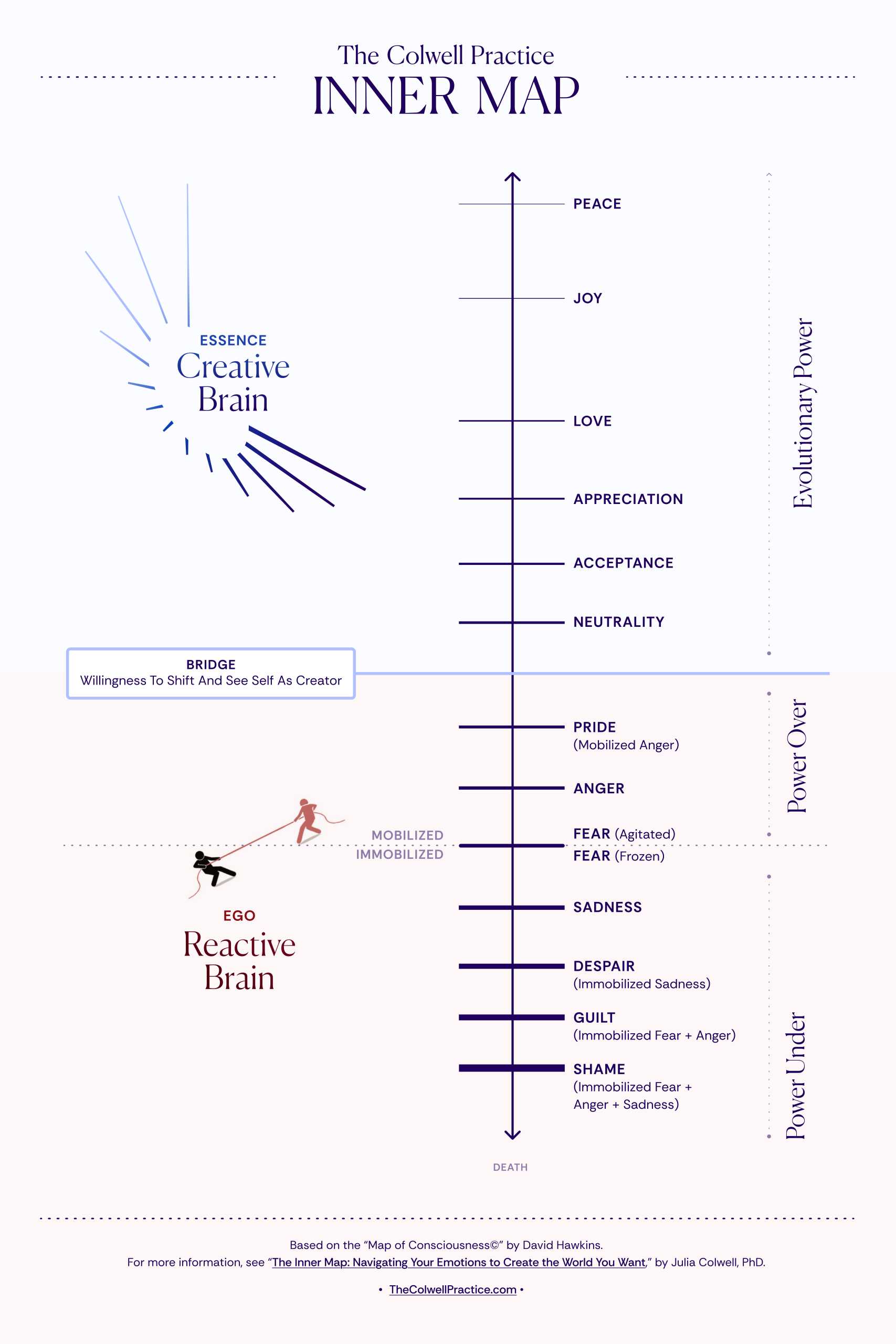
The Inner Map is the orientation diagram of the EPI practice. It names a vertical scale of human states with two halves divided by a movable Bridge. The bottom half — Reactive Brain / EGO — is the contracted, protective register where survival patterns run us. The top half — Creative Brain / ESSENCE — is the open, creative, connected register where co-creation, presence, and aliveness become available. The map names where we are at any moment and what the move to a different place looks like.
Life is feedback showing us where we are on the map. The practice is awareness (noticing where we are) and choice (crossing the Bridge on purpose when the situation calls for it). The Bridge itself is named: “Willingness to shift and see self as creator.”
The diagram
The same diagram also appears as the handout version in
/assets/colwell-inner-map-handout-032.png, from the Colwell
Practice Immersion Manual v3, p. 32.
The states (top to bottom)
The map lays out states on a single vertical axis. The right edge of the diagram annotates three power positions corresponding to the three sections of the axis.
Creative Brain / ESSENCE — Evolutionary Power
Above the Bridge. The figure is open, dancing, light radiating. These states feed creative engagement with reality; they are where co-creation becomes possible.
| State | |
|---|---|
| Peace | the most open / most rested |
| Joy | |
| Love | |
| Appreciation | |
| Acceptance | |
| Neutrality | the threshold above the Bridge |
The Bridge
“Willingness to shift and see self as creator.” The Bridge is the move itself — not a state but the willingness to make the crossing. It names that a practitioner is not a victim of their state; they are someone who can choose to shift, and the first move is wanting to.
Reactive Brain / EGO — Power Over (mobilized)
Below the Bridge, upper section. The figure is mobilized — energy is moving outward, against the world or others.
| State | Composition |
|---|---|
| Pride | mobilized anger |
| Anger | |
| Fear (Agitated) | the transition into mobilization |
Reactive Brain / EGO — Power Under (immobilized)
Below the Bridge, lower section. The figure is collapsed — energy is contracted inward, frozen.
| State | Composition |
|---|---|
| Fear (Frozen) | the transition into immobilization |
| Sadness | |
| Despair | immobilized sadness |
| Guilt | immobilized fear + anger |
| Shame | immobilized fear + anger + sadness |
| Death | named as the floor of the immobilized register |
Functions of Each Level of Consciousness
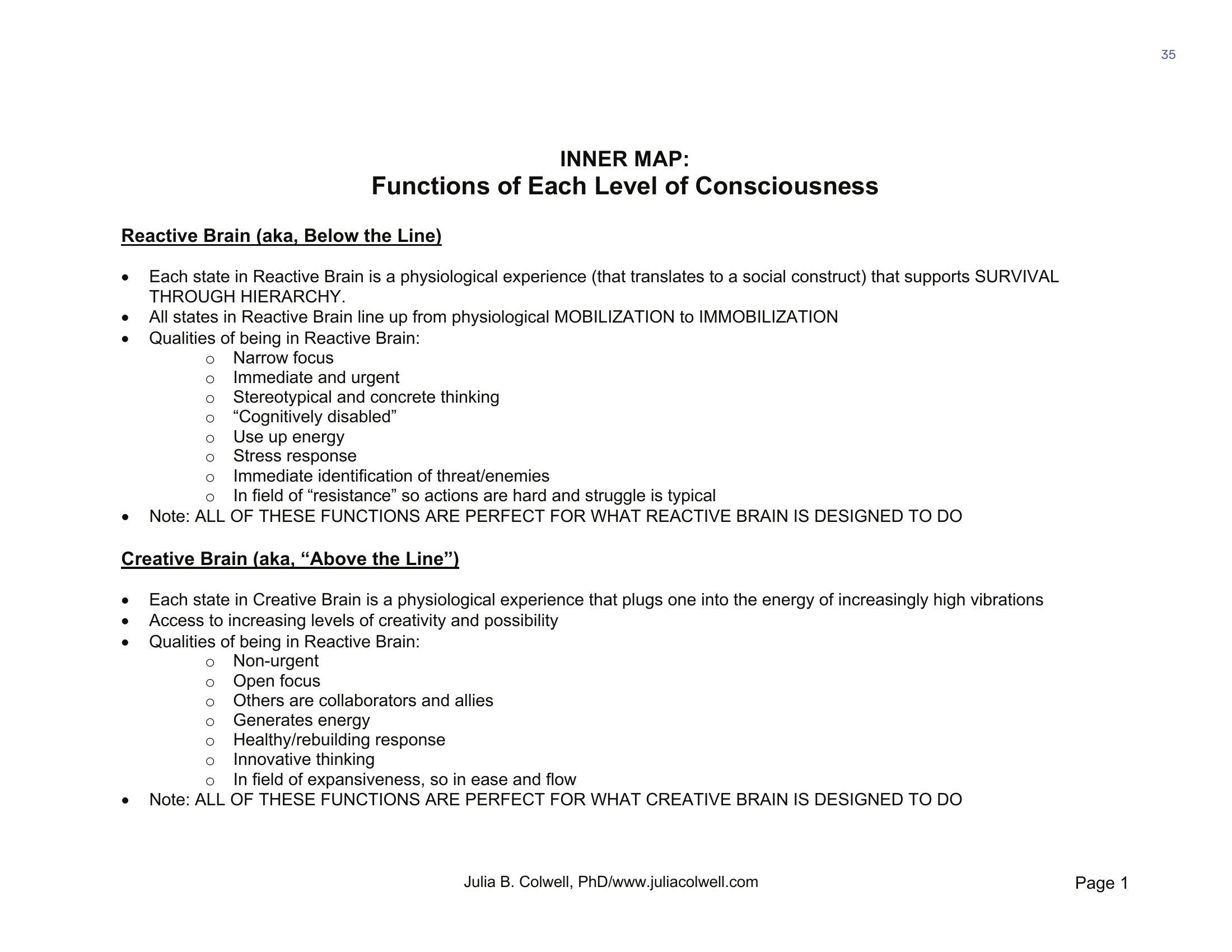
Each state on the map has a function — what it is designed by biology to do. Knowing the function is what lets a practitioner read their own state with curiosity instead of judgment.
All states in Reactive Brain line up from physiological mobilization to immobilization. ALL OF THESE FUNCTIONS ARE PERFECT FOR WHAT REACTIVE BRAIN IS DESIGNED TO DO. — Manual v3, p. 35
This is the load-bearing companion to the Reactive Brain is not the enemy caveat below: every state has a job that, in the right context, is exactly right.
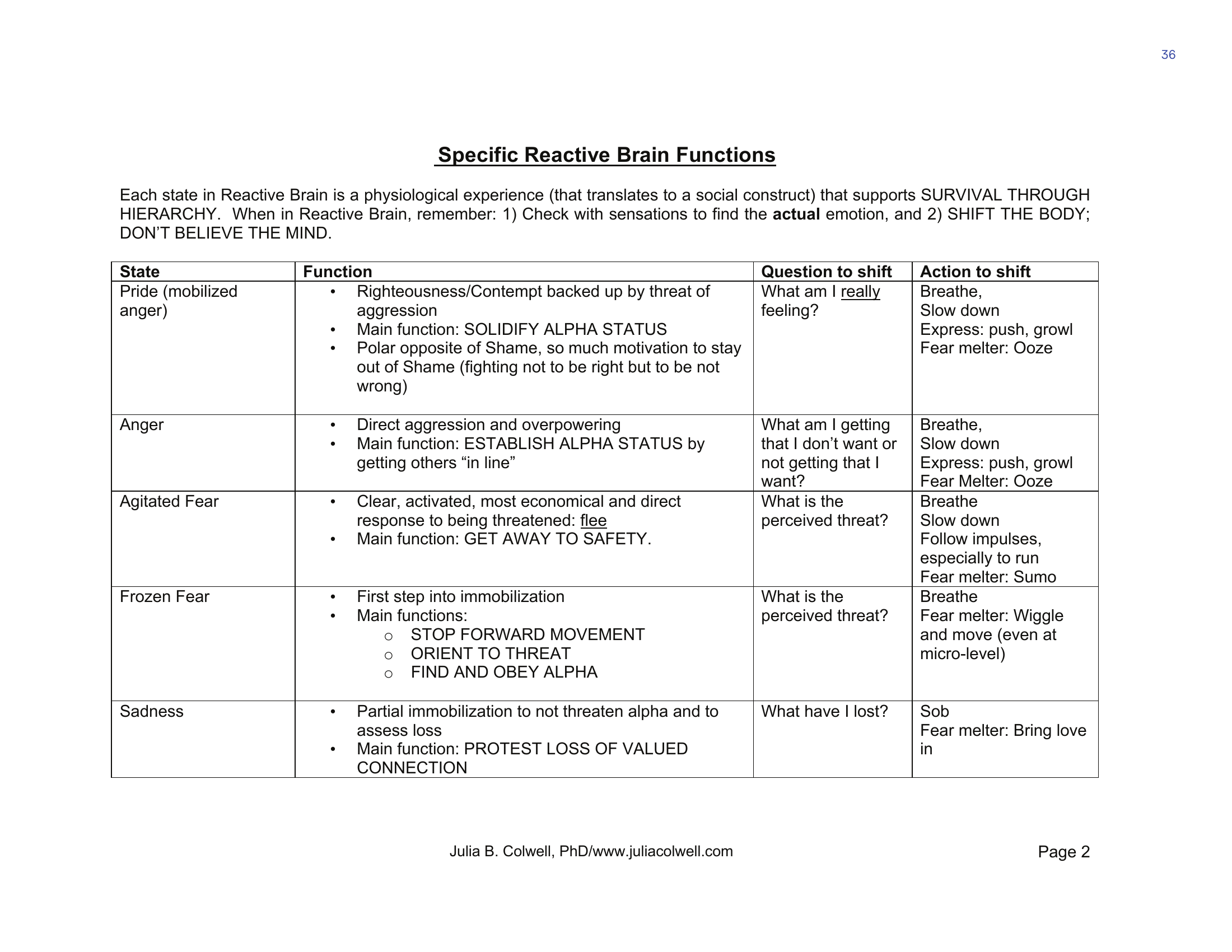
Reactive Brain — survival through hierarchy
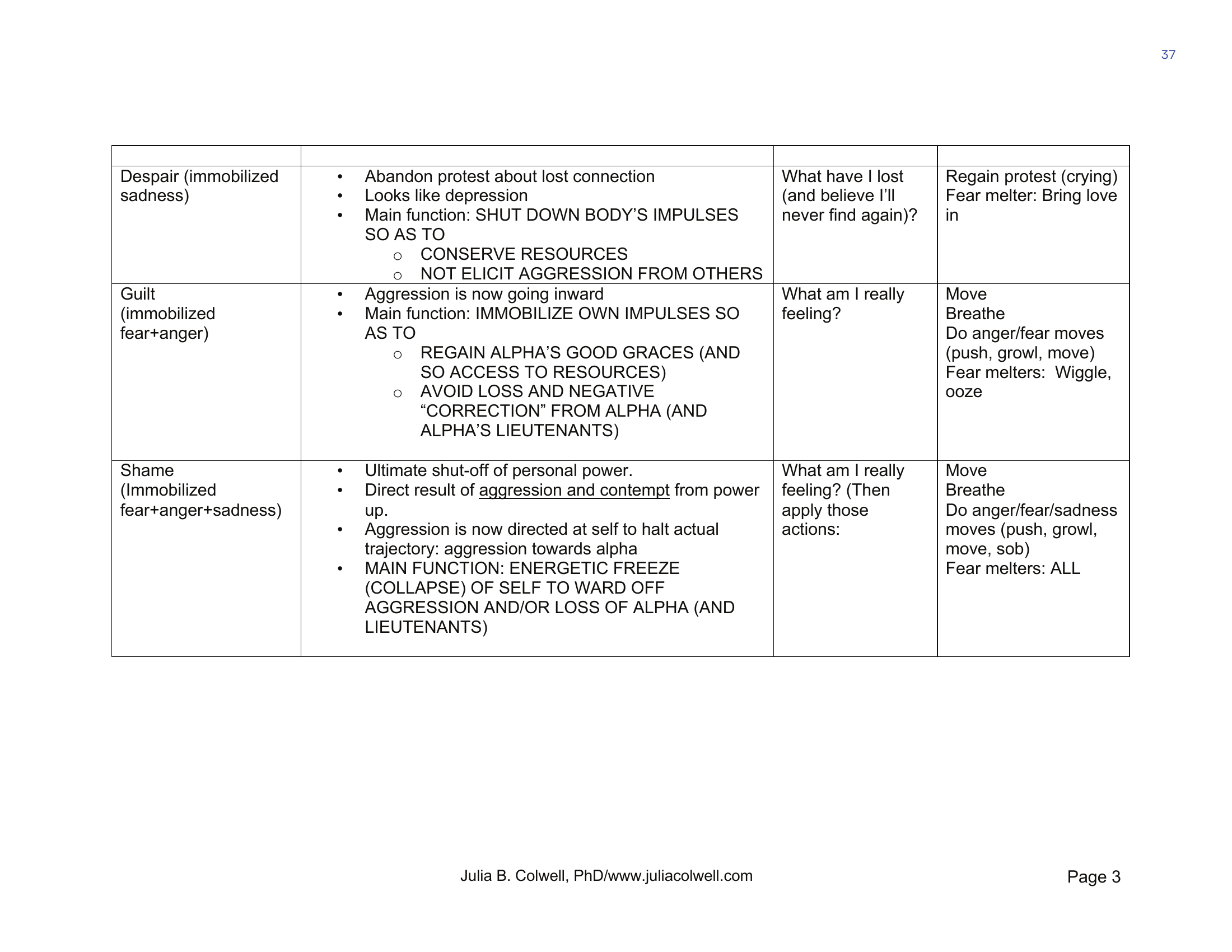
| State | Function | Question to shift | Action to shift |
|---|---|---|---|
| Pride (mobilized anger) | Solidify alpha status. Polar opposite of Shame — fighting not to be right, but to be not wrong. | What am I really feeling? | Breathe, slow down, push, growl. Fear melter: ooze. |
| Anger | Direct aggression — establish alpha status by getting others “in line.” | What am I getting that I don’t want, or not getting that I want? | Breathe, slow down, push, growl. Fear melter: ooze. |
| Fear (Agitated) | Clear, activated response to threat: flee. Get away to safety. | What is the perceived threat? | Breathe, slow down, follow impulses to run. Fear melter: sumo. |
| Fear (Frozen) | First step into immobilization. Stop forward movement; orient to threat; find and obey alpha. | What is the perceived threat? | Breathe. Fear melter: wiggle and move (even at micro-level). |
| Sadness | Partial immobilization to not threaten alpha. Protest loss of valued connection. | What have I lost? | Sob. Fear melter: bring love in. |
| Despair (immobilized sadness) | Shut down body’s impulses to conserve resources and not elicit aggression. | What have I lost (and believe I’ll never find again)? | Regain protest (crying). Fear melter: bring love in. |
| Guilt (immobilized fear + anger) | Aggression turned inward — regain alpha’s good graces, avoid loss and negative correction. | What am I really feeling? | Move. Breathe. Do anger/fear moves (push, growl, move). Fear melters: wiggle, ooze. |
| Shame (immobilized fear + anger + sadness) | Ultimate shut-off of personal power. Direct result of aggression and contempt from “power up.” Energetic freeze to ward off aggression and/or loss. | What am I really feeling? Then apply those actions. | Move. Breathe. Do anger/fear/sadness moves (push, growl, move, sob). Fear melters: all. |
Creative Brain — thriving through co-creativity
| State | Function | Question to ask | Shift in power |
|---|---|---|---|
| Neutrality | Facing into what is. | What have I not faced? | Out of resistance and into flow. |
| Acceptance | Accepting what is. | What have I not accepted? | Find the perfection in the moment; choose next step from that wave. |
| Appreciation | Orienting to the positive of what is. | What can I appreciate about what is? | Plug into the increasingly powerful energy of nature. |
| Love | Joining with the energy of the universe to co-create. | How can I generate the energy of love and connect with the whole? | Loving energy meets the energy of love in the world, exponentially increasing internal fire. |
| Joy | Celebration of life. | How can I connect with pure life energy? | Very high vibration creates dancing molecules. |
| Peace | Exist as one with all. | How can I connect with the Unity? | Even higher vibration connects to the unity of life, pure knowledge that all is well. |
The Reactive-side table is what makes the Inner Map operational: a practitioner who can name “I’m in Frozen Fear, the function is to orient to threat, the move is to wiggle and breathe” has the whole practice in one sentence.
The full handout (4 pages from the manual, pp. 35-38):
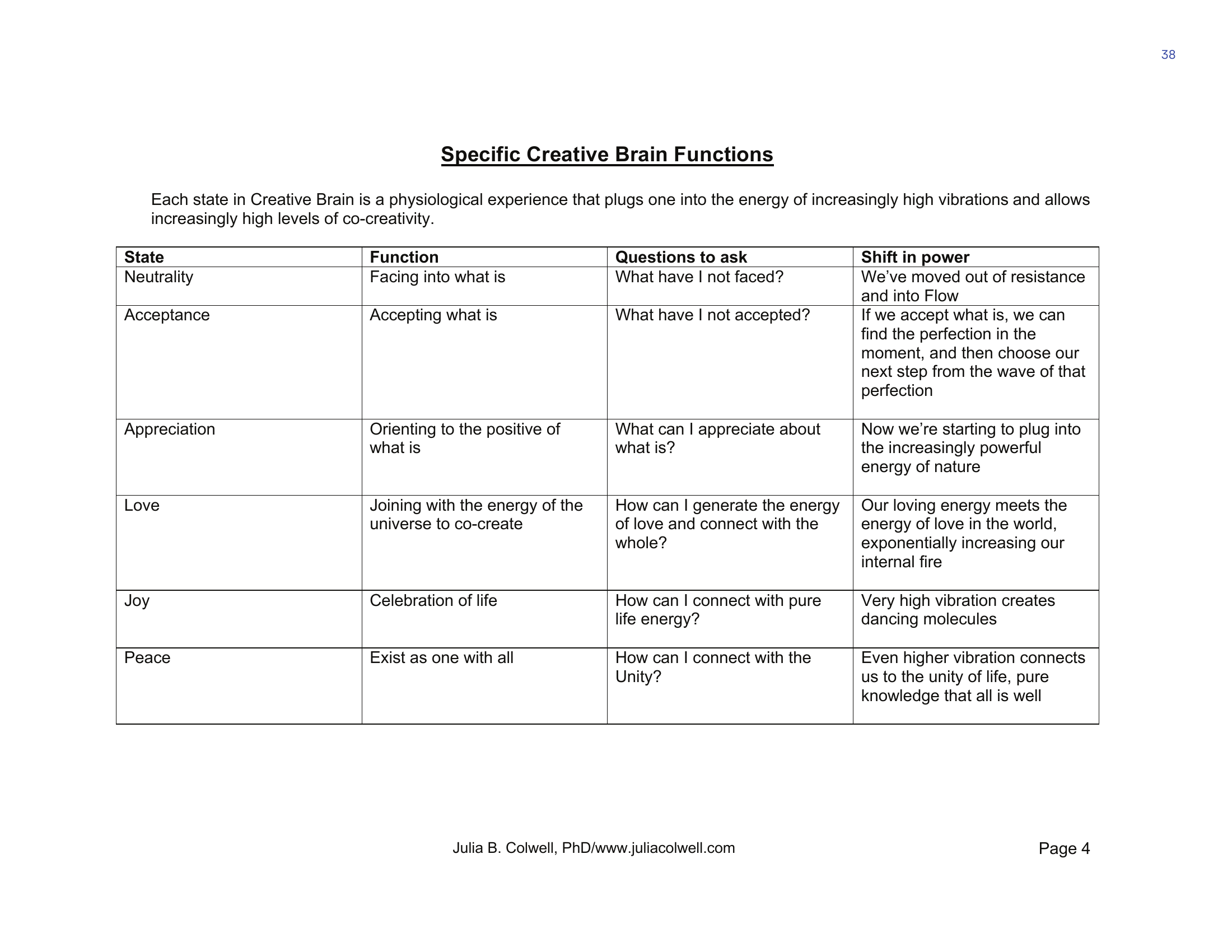
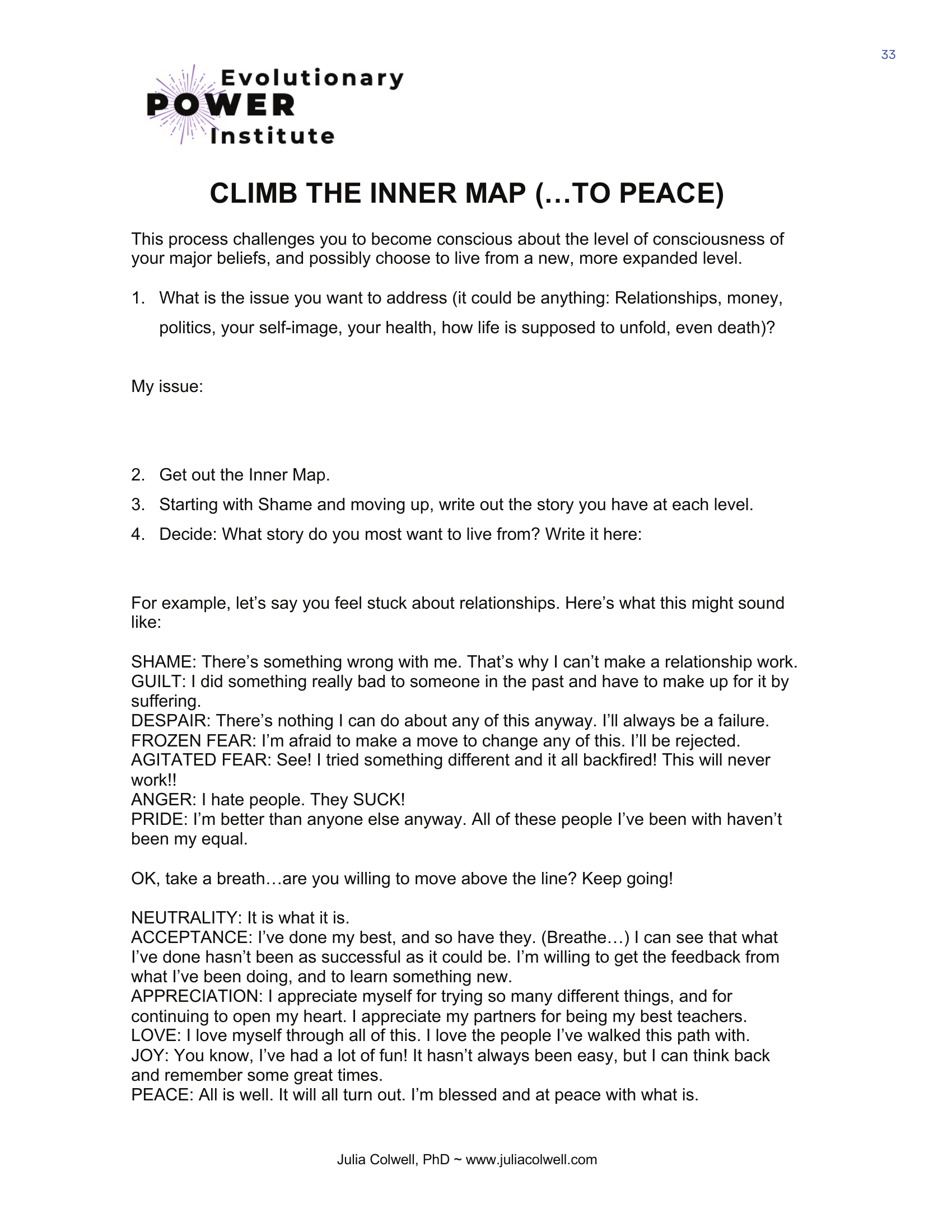
Climb the Inner Map exercise
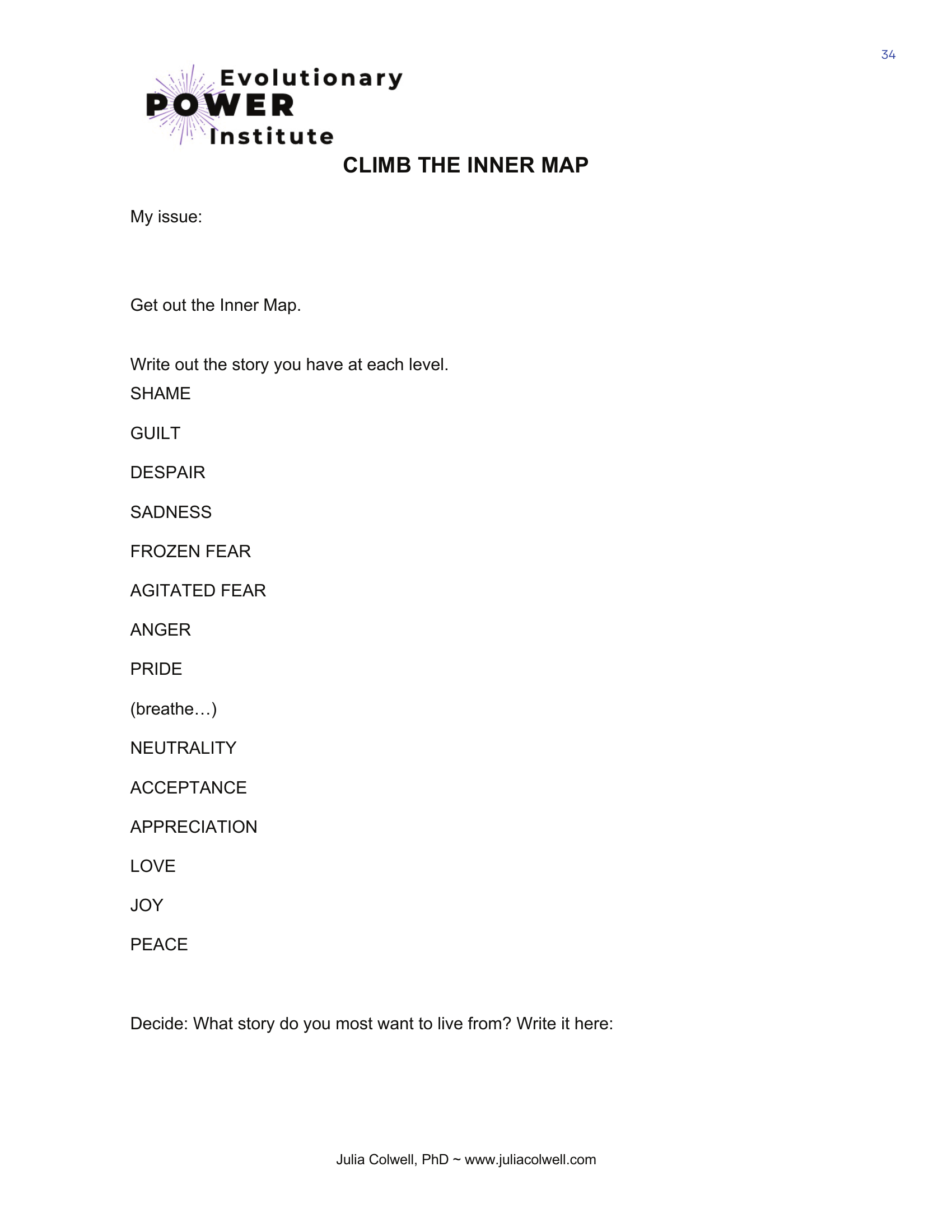
A complementary practice: starting at Shame and moving up, write the story you have at each level — then decide which story to live from. The full canonical exercise (Manual v3, pp. 33-34) gives a worked example for relationships at each level:
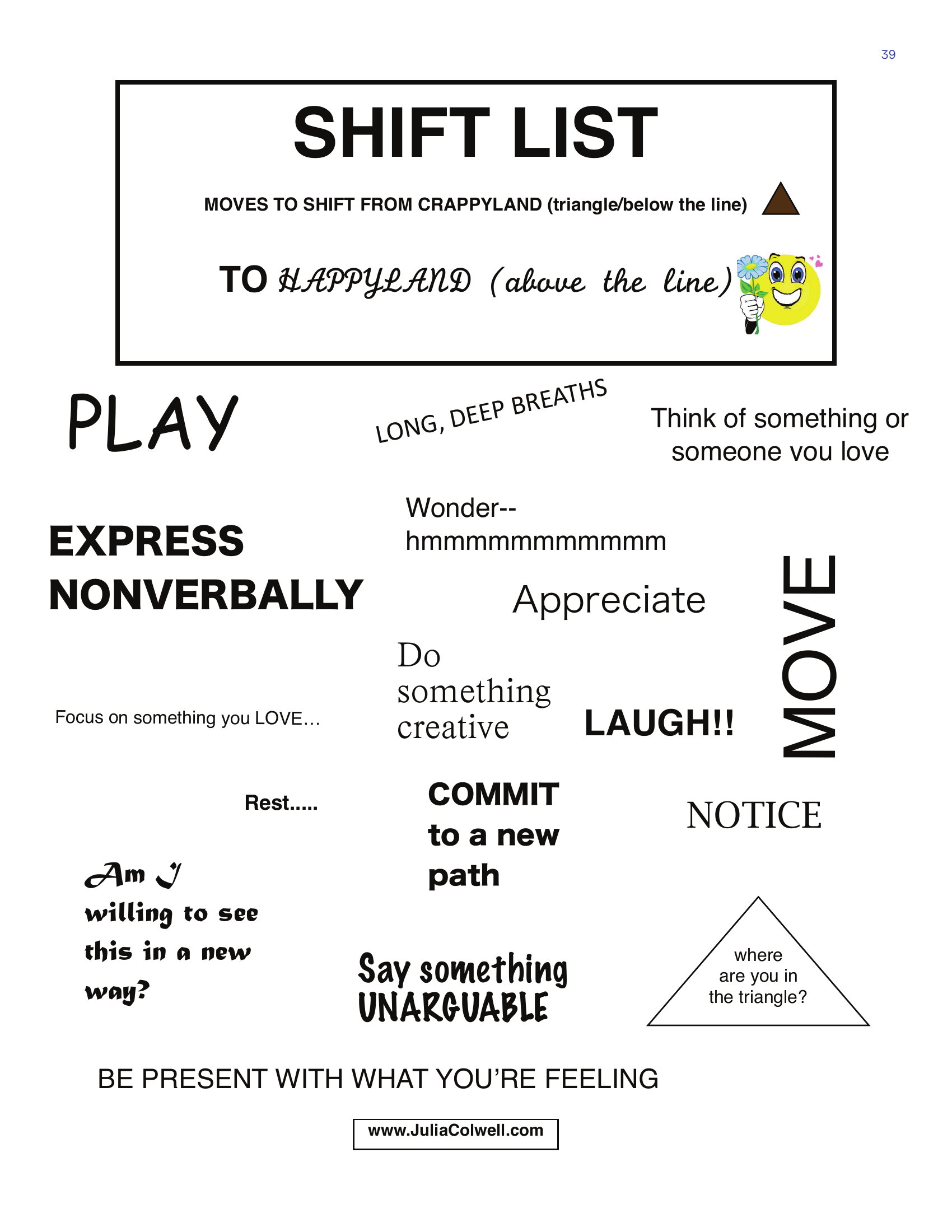
Shift List
The canonical Crappyland → Happyland shift moves handout — a word-cloud of moves that interrupt Reactive Brain (Manual v3, p. 39):
How to read the map
- Locate yourself. Where on the map are you right now? Sensation in the body is the most reliable indicator (see sew). Naming the specific state — I am in Anger right now. I am in Guilt right now. I am in Appreciation right now. — is itself a move.
- Recognize the section. Power Over (mobilized reactive), Power Under (immobilized reactive), or Evolutionary Power (essence). The section tells you what kind of move is available next.
- Use the Bridge. The crossing from below to above is not a leap; it is willingness to shift and see self as creator. The Bridge is the doorway. Standing at it and being willing to walk through is the practice.
- Stay or move on purpose. Sometimes Reactive Brain is exactly the right response to the situation (see the caveat below). The practice is the capacity to tell the difference and choose deliberately.
Reactive Brain is not the enemy — load-bearing caveat
Reactive Brain is the mammalian survival system. It is essential. Fear keeps us alive. Anger signals us that there’s a perceived intrusion or obstacle. Hierarchy is how mammals organize for group survival. Reactive Brain is brilliant at what it’s for.
What Reactive Brain doesn’t do well is co-creative relationships, creative expansion, and open-ended growth. The practice is not to get rid of Reactive Brain. The practice is awareness and choice.
— EPI Expansion Strategy v5, Part One
This caveat is preserved verbatim because the most common misread of the Inner Map is “Reactive Brain bad, Creative Brain good — get above the Bridge and stay there.” That misread is inaccurate and leads to spiritual bypass — people denying legitimate survival signals in the name of being “above the line.”
The diagram’s EGO label and the vertical hierarchy could each enable that misread on their own. The caveat is what protects against it. v5 names this “the correction most likely to be lost at scale,” and the team should treat it as load-bearing canonical commentary alongside the diagram itself.
What this tool does for the rest of the practice
- It is the orientation device every other tool operates inside. SEW is a move; the Inner Map is what tells you why the move is needed and what direction to make it in.
- It is what the Bridge moves toward — “see self as creator” is the core authorship move that fact, karpman-triangle work, withhold-withdraw-project, and the integrity-and-essence tools all enact in their own register.
Facets served
- facet-navigating-inner-world — the Inner Map IS the foundational map for this facet.
- facet-discovering-true-power — the Power Over / Power Under / Evolutionary Power axis is named directly on the diagram. See also power-with-over-under (the deep-dive tool that elaborates this axis). The Inner Map is the visual home where Power Over/Under lives.
- facet-aligning-with-essence — the entire upper register of the map (Neutrality through Peace) is the lived territory this facet develops.
- facet-translating-body-wisdom — every state on the map has body signature; reading the body for sensation is how a practitioner locates themselves on the map.
- facet-getting-unstuck — the Bridge is the unstuck-move depicted.
Related principles
- principle-2 — translating the body’s wisdom; the map’s body-based reading is how Principle 2 is enacted in real time.
- principle-3 — the practice as presencing via SEW; the Inner Map is the what SEW returns one to awareness of.
- principle-9 — Spiritual, Not Religious. The diagram explicitly names ESSENCE as the upper register and credits a lineage (Hawkins, Colwell) that is spiritual but non-denominational; consistent with Principle 9.
Containers it lives in
Every container — the open meeting, solitary practice, Guide–Traveler, the Safe Harbor opening (the map is what “this is a space for practice” practices on). The Inner Map is the orientation reference the rest of the practice operates inside.
Source and attribution
Canonical sources:
/assets/Inner-Map-24x36-1-scaled.png— the 24×36 poster diagram./assets/colwell-inner-map-handout-032.png— the same diagram as the printable handout, from the Colwell Practice Immersion Manual v3, p. 32.raw/The Colwell Practice Immersion Manual-v3 with cover.pdf— Section II (“The Inner Map: Navigating The Internal World”), pp. 27-40, holds the canonical prose, the Functions of Each Level of Consciousness table (transcribed below), the Climb the Inner Map exercise, and the Shift List handout.
Footer attribution on the diagram, preserved verbatim:
Based on the “Map of Consciousness®” by David Hawkins. For more information, see “The Inner Map: Navigating Your Emotions to Create the World You Want” by Julia Colwell, PhD. TheColwellPractice.com →
Lineage:
- David Hawkins, MD, PhD — Power vs. Force (1995) introduced the Map of Consciousness®, a calibrated scale of emotional/spiritual states. EPI’s Inner Map adapts this scale rather than restates it.
- Julia Colwell, PhD — wrote The Inner Map: Navigating Your Emotions to Create the World You Want and authored this diagram.
The Colwell Practice / EPI relationship — resolved 2026-05-25. Julia Colwell is on the EPI team and her body of work is the EPI tool library. The relationship is two modalities of the same body of work, not two institutions: The Colwell Practice is the professionally guided modality (coaches with clients, Code of Ethics, fees); EPI is the peer-led modality (members holding format, no professional class, donation-only). Crediting Julia Colwell — and through her, Gay & Kathlyn Hendricks — on every tool sourced from her work is the standing discipline. See colwell-to-epi-translation for the translation reference and standing attribution pattern.
Secondary source (commentary):
raw/EPI_Expansion_Strategy_v5.docx.md— Part One, “Reactive Brain is not the enemy” section. Preserved verbatim above as the load-bearing caveat.
Status notes
canonical — promoted from anchor placeholder to full canonical
writeup 2026-05-25 from the canonical diagram in /assets/. The
Functions of Each Level of Consciousness tables were added
2026-05-25 from the Colwell Practice Immersion Manual v3 (pp. 35-38).
Polyvagal mapping the manual names alongside this tool (p. 30) and worth carrying in the wiki:
- Sympathetic nervous system = the mobilized Reactive states (Pride, Anger, Agitated Fear).
- Dorsal vagal system = the immobilized Reactive states (Frozen Fear, Sadness, Despair, Guilt, Shame — “freeze, faint, fawn”).
- Ventral vagal state = Creative Brain — overall relaxation, safety, openness, connection, flexibility.
The manual also names “thoughts anchor, feelings flow” as a load- bearing aphorism for the map: each level on the Inner Map is anchored by thought, while feelings flow through. The story you tell yourself is a direct clue to the level you’re in, and changing the story (from a higher level) is one way to shift state — moving the energy through the body is the other (see sew, experiencing-your-feelings).
Outstanding follow-ups for the canonical archive:
- Julia Colwell’s book The Inner Map: Navigating Your Emotions to
Create the World You Want is the canonical long-form description.
Not currently in
raw/. - A “how to teach it to a newcomer” page lives at the wrapper layer, not here — would be a separate framing page if the team drafts one.