Power With / Power Over / Power Under
What it is
Three instinctive responses every human carries in the body:
- Power Over — domination. The mobilized Reactive Brain register. Pride, anger, agitated fear. Energy pushed outward to control, command, dominate.
- Power Under — submission. The immobilized Reactive Brain register. Frozen fear, sadness, despair, guilt, shame. Energy collapsed inward to comply, placate, disappear.
- Power With — co-creation. Creative Brain. The relational counterpart of inner-map’s Evolutionary Power. Connection, collaboration, mutual aliveness.
When triggered into Reactive Brain, the body automatically goes into Power Over or Power Under in milliseconds — wired in over millions of years of mammalian evolution. When in Creative Brain, the body automatically shifts into Power With.
The practice is not to not go into Power Over/Under — that is not possible. The practice is to notice which one you have gone into, and shift back to Power With.
Where this lives on the Inner Map
The inner-map diagram names all three:
- The right edge of the diagram is annotated Evolutionary Power (above the Bridge), Power Over (mobilized Reactive), Power Under (immobilized Reactive).
- The Bridge — “Willingness to shift and see self as creator” — is the move from Power Over/Under into Power With.
Power With is the relational name; Evolutionary Power is the intrapersonal name. They are two views of the same register.
Why this matters — power imbalances as load-bearing
Power imbalances are the invisible factor that underpin all problems, from the intrapersonal, to the interpersonal, to the institutional, systemic, and ideological. — Manual v3, p. 9
Whenever someone is triggered into Reactive Brain, the brain defaults to hierarchy as a survival response. Two people will sort into Power Over and Power Under fast — it is not personal, not conscious, not learned behavior. It is the mammalian nervous system doing its job.
The catch: hierarchy works for emergencies. It does not work for day-to-day connection. Power Under will eventually rebel, resist, or withdraw. Power Over will eventually escalate. The dance is unstable. The way out is for each person to shift their own physiology back into Creative Brain.
How to recognize each register — body signals
The manual gives a long, body-based checklist for each of the three positions. The lists are not exhaustive — they came from couples and individuals exploring what their bodies actually do. Use them to notice which items describe you, and under what circumstances.
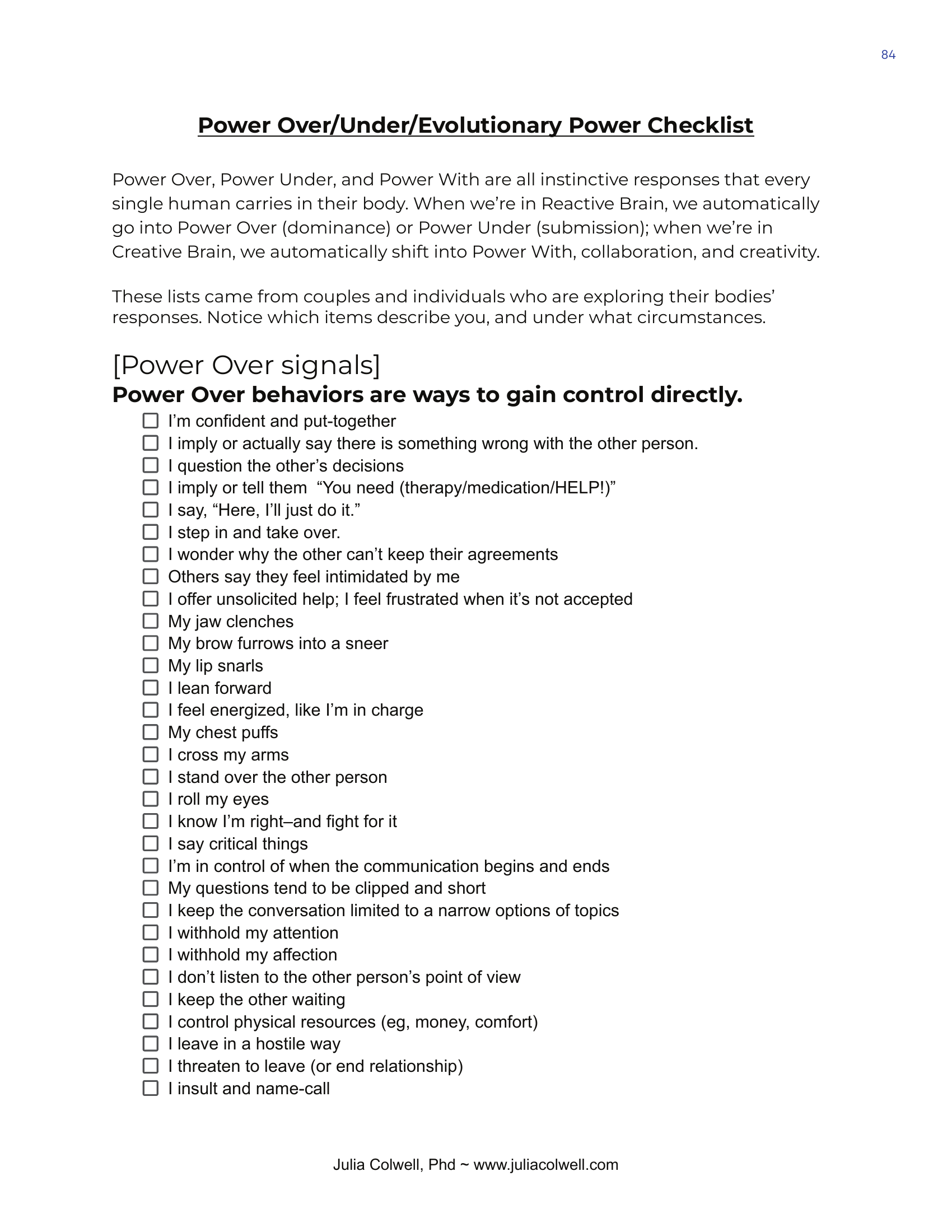
Power Over — ways to gain control directly
The full checklist is in the handout (/assets/colwell-power-checklist-084.png
and colwell-power-checklist-085.png). Representative signals:
- I’m confident and put-together.
- I imply or say there is something wrong with the other person.
- I say “Here, I’ll just do it.”
- I step in and take over.
- My jaw clenches. My brow furrows into a sneer. My lip snarls.
- I stand over the other person. I lean forward. My chest puffs.
- I know I’m right and fight for it.
- I withhold my attention. I withhold my affection.
- I leave in a hostile way. I threaten to leave.
- I’m sarcastic. I’m dismissive. I’m self-righteous.
- I interrupt or speak over the other person.
- I feel mobilized, angry, like I could fight.
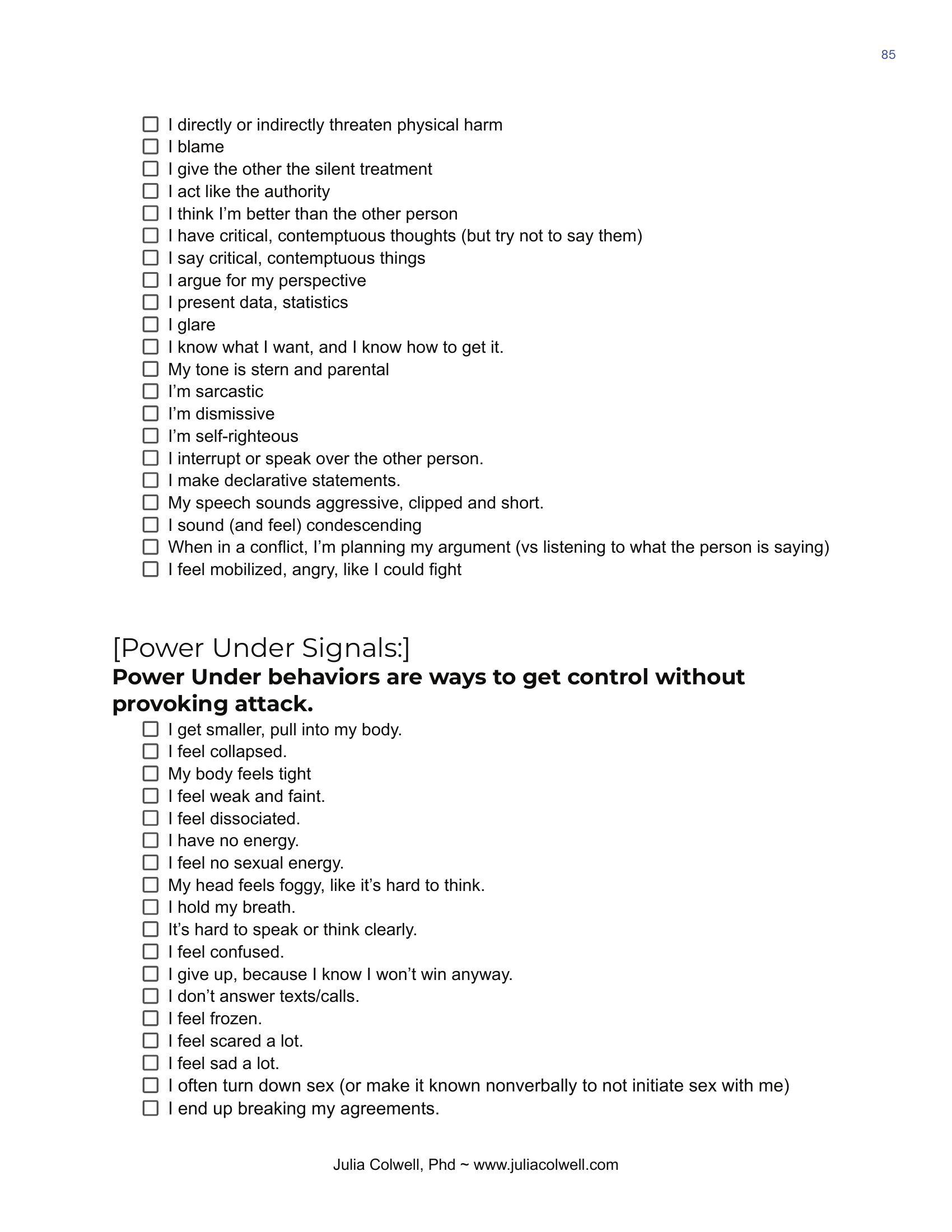
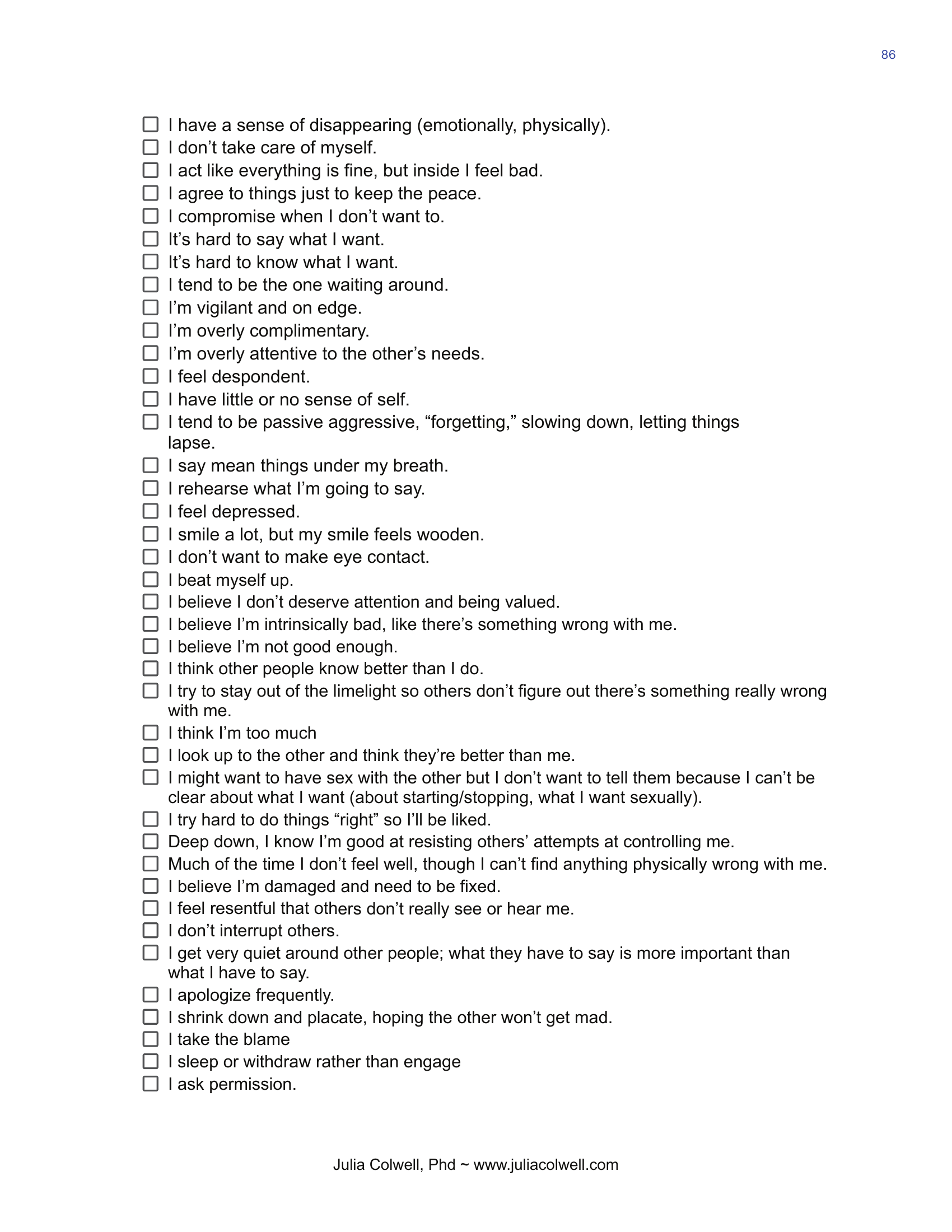
Power Under — ways to get control without provoking attack
The full checklist is in colwell-power-checklist-085.png through
colwell-power-checklist-086.png. Representative signals:
- I get smaller, pull into my body. I feel collapsed.
- I feel weak and faint. I dissociate. I have no energy.
- I hold my breath. It’s hard to speak or think clearly.
- I give up, because I know I won’t win anyway.
- I act like everything is fine, but inside I feel bad.
- I agree to things just to keep the peace.
- I compromise when I don’t want to.
- It’s hard to say what I want. It’s hard to know what I want.
- I’m vigilant and on edge. I’m overly complimentary.
- I’m passive-aggressive — “forgetting,” slowing down, letting things lapse.
- I rehearse what I’m going to say.
- I take the blame. I apologize frequently.
- I end up breaking my agreements.
Power Under behaviors are ways to get control without provoking attack. — Manual v3, p. 85
This naming is load-bearing: Power Under is not powerlessness. It is a control strategy. Passive resistance, refusal, and emotional withdrawal are all forms of control that don’t trip the dominance response. The Victim in karpman-triangle often has more control than anyone in the system, despite appearing powerless.
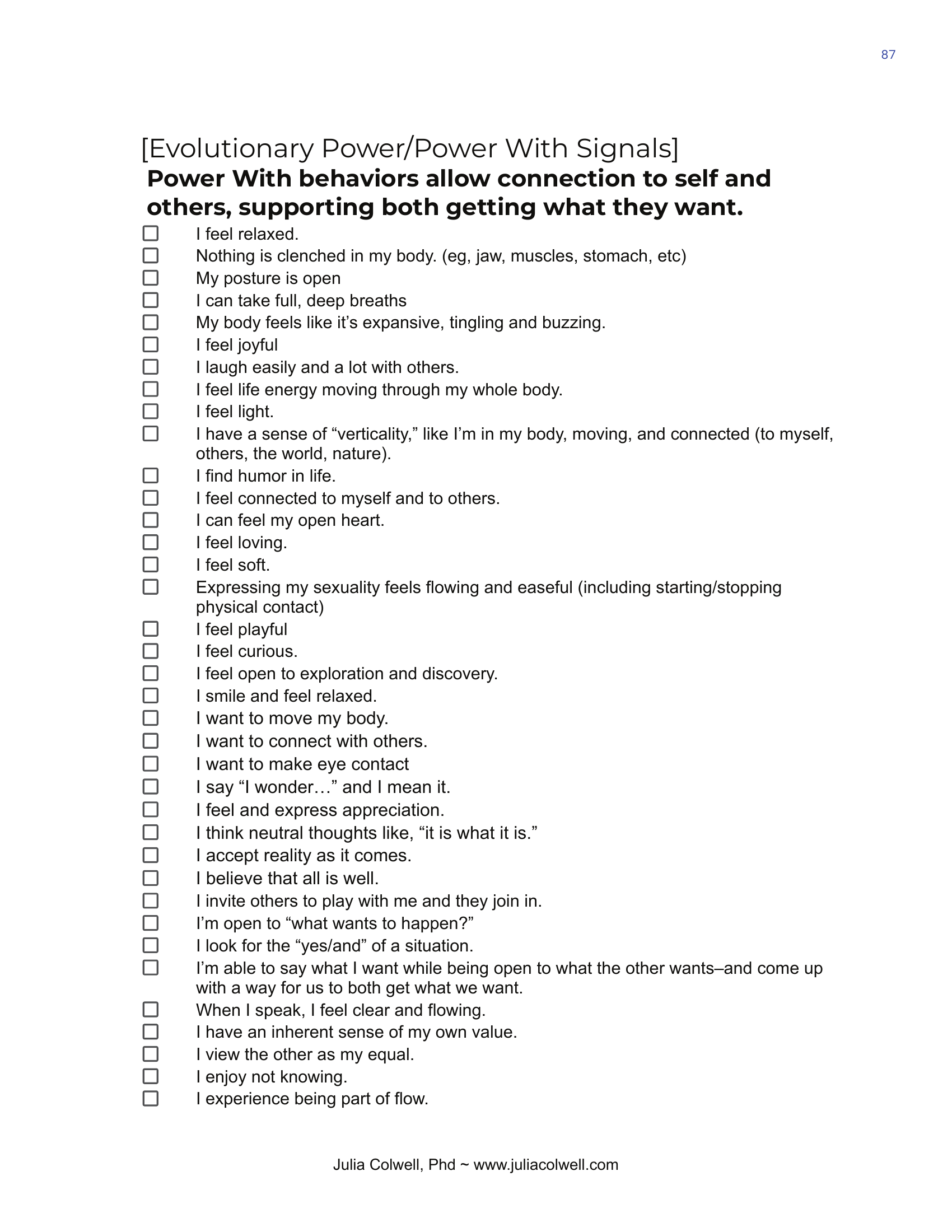
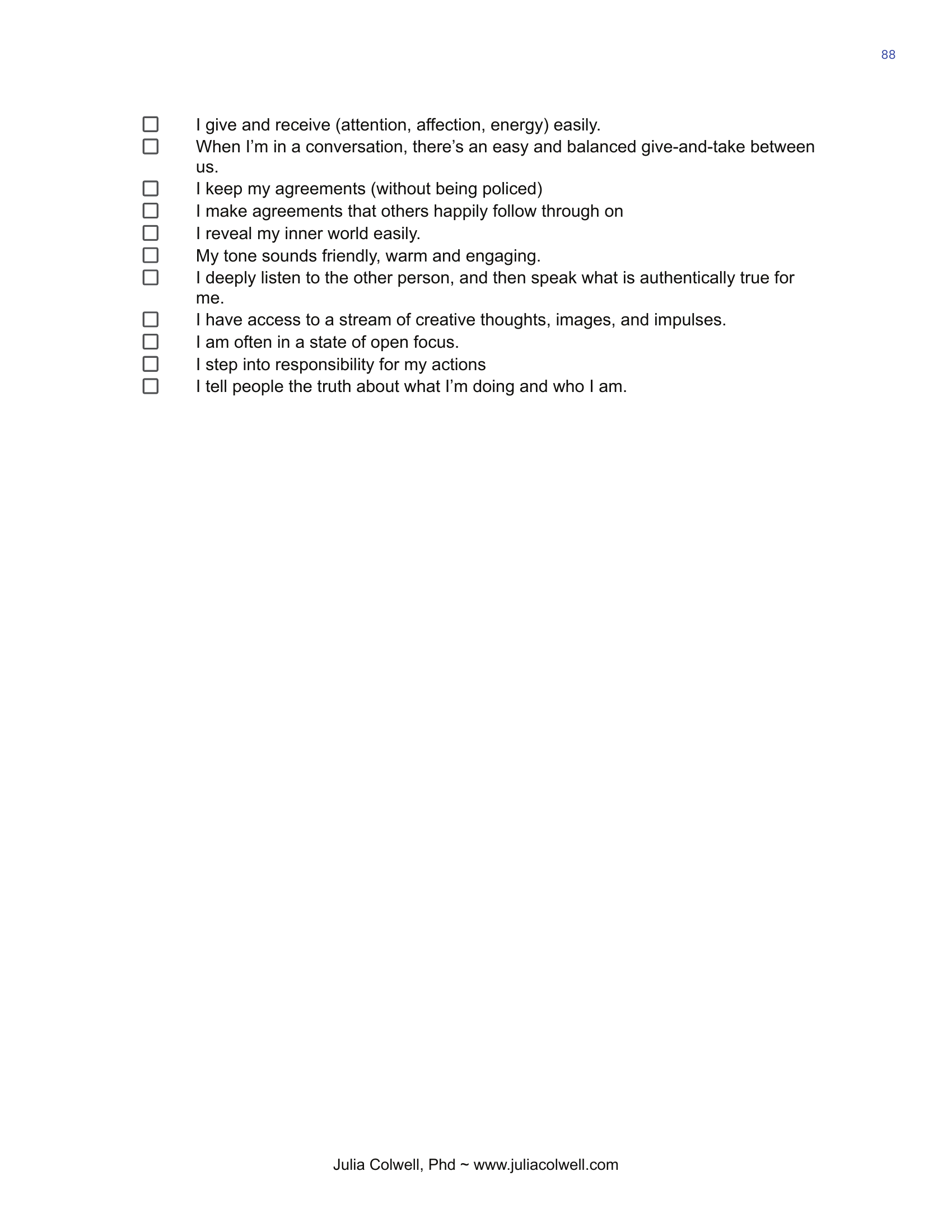
Power With — connection to self and others, supporting both getting what they want
The full checklist is in colwell-power-checklist-087.png through
colwell-power-checklist-088.png. Representative signals:
- I feel relaxed. Nothing is clenched.
- My posture is open. I can take full, deep breaths.
- My body feels expansive, tingling, buzzing.
- I feel joyful. I laugh easily and a lot.
- I feel light. I have a sense of “verticality.”
- I feel connected to myself and to others.
- I find humor in life. I feel curious. I feel playful.
- I’m open to exploration and discovery.
- I want to move my body. I want to connect.
- I say “I wonder…” and I mean it.
- I think neutral thoughts like “it is what it is.”
- I look for the yes/and of a situation.
- I’m able to say what I want while being open to what the other wants — and come up with a way for us both to get what we want.
- I keep my agreements (without being policed).
- I deeply listen, then speak what is authentically true for me.
- I have access to a stream of creative thoughts, images, and impulses.
The full canonical checklist (all five pages)
The move
There is no single step-by-step move — the move is noticing and shifting your own physiology. The supports:
- Notice. Use the body checklists. Where are you right now? Your jaw, your shoulders, your breath, your stance.
- Take time. Stress chemicals take time to metabolize. Allow yourself and others enough time and space to re-regulate before trying to communicate or make an agreement.
- Shift your own physiology. This is the only place anyone has real control. See sew, fact, play, and the Inner Map’s Functions of Each Level of Consciousness table for state-specific shifts.
- Use Power With tools when in Power With. Great agreements come from Creative Brain (see creative-brain-communication). Trying to make an agreement from Power Over/Under will reproduce the power dynamic in the agreement itself.
A note for compassion
Learning to live in Evolutionary Power is about building awareness, practicing new tools, and most of all, cultivating forgiveness and patience for ourselves and those we love when we fall back into Power Over or Power Under. — Manual v3, p. 83
Everyone falls back. The practice is the recovery, not the perfection.
Facets served
- facet-discovering-true-power — this tool is the foundational frame for this facet.
- facet-navigating-inner-world — the Power Over / Power Under axis is one of the two main axes of the Inner Map.
Related principles
- principle-12 — no leaders, no gurus; attract rather than promote. The fellowship-level enactment of Power With.
- principle-11 — no professional class; willing-to-follow-format can host. The structural enactment of Power With at the meeting level.
Related tools
- inner-map — the visual home of this axis.
- karpman-triangle — Hero/Villain are Power Over expressions; Victim is a Power Under expression. The triangle is what Power Over/Under looks like in a multi-person dynamic.
- creative-brain-communication — the agreement-making tool for Power With.
- sew, fact — physiological shift moves out of Power Over/Under.
Source and attribution
Primary source:
raw/The Colwell Practice Immersion Manual-v3 with cover.pdf, Section VII (Power Struggles: The Hidden Determinant Behind All Relationship Conflict), pp. 80-89.
Visual handout:
/assets/colwell-power-checklist-084.pngthroughcolwell-power-checklist-088.png— the five-page Power Over/Under/With checklist.
Lineage:
- The term Power Over / Power Under originated with a social worker in 1918 and was later popularized through feminist theory (Manual v3, p. 82).
- Power With as the third position is Julie Colwell’s framing, drawing on the broader Hendricks lineage.
Status notes
canonical — promoted from needs-export 2026-05-25 from the
Colwell Practice Immersion Manual v3 (Section VII). The body-
signal checklists are the operational core; they let a practitioner
locate themselves quickly without needing to interpret a state
verbally first.