SEW (Sensations, Emotions, Wants)
What it is
The core practice tool of EPI. The reliable way to come back to presence and to find what is actually true and wanted in this moment. SEW names three moves practiced in sequence:
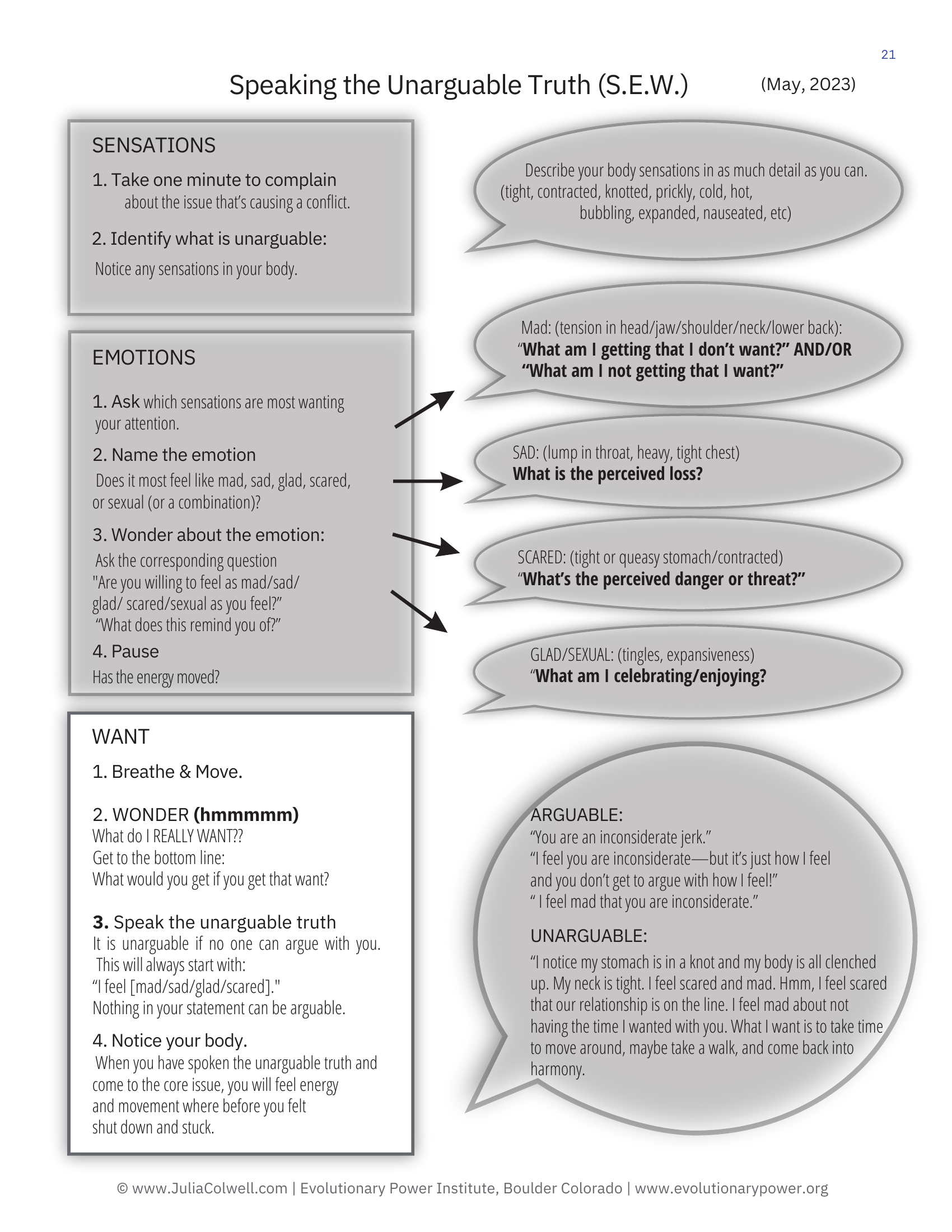
- S — Sensation. Physical and felt experience in the body, right now. “My jaw is tight. There’s heat in my chest. There are butterflies in my stomach.” Sensations are unarguable — the practitioner cannot lose an argument about what they feel.
- E — Emotion. Energy in motion. Five emotions are named: anger,
fear, sadness (Reactive Brain) and glad, sexual/aroused/creative
(Creative Brain). Each carries information the body is trying to
deliver:
- Anger — what I want / don’t want
- Fear — perceived threat or danger
- Sadness — perceived loss
- Glad / Sexual / Aroused / Creative — what excites me, what I am celebrating
- W — Want. Once sensation and emotion have moved, the want underneath becomes available — and it comes from the body, not the mind. A Reactive Brain “want” (“I want you to listen!”) is the persona talking. A Full Body want (see full-body-yes-no) names what the practitioner actually wants from themselves, which is the only place real power lives.
SEW is the operational form of principle-2 (translating the body’s wisdom) and principle-3 (the practice is one-person presencing via SEW). It is also the entry point for nearly every other tool in the library — the place every depth practice begins.
The move
- Tune in. Notice the body. “I notice ____” Attention plus breath moves energy; the practice is letting that movement happen.
- Name a sensation. Concrete and local. Not interpretation — sensation. Sensation interrupts story.
- Name the emotion present. Mad, sad, glad, scared, sexual/creative. Let it be what it is. Emotion interrupts defense. (See emotional-cycles for the shape of the arc the practitioner is staying with.)
- Let the cycle complete. Stay with the sensation, breathe, allow movement or expression if the body asks for it. The body completes its own cycle when not interrupted. (See experiencing-your-feelings for the depth practice of this step.)
- Name the want underneath. What do I really want — from me, not from anyone else? The want surfaces once the activation has cleared. Want restores agency.
The sequence matters. A “want” named while still in Reactive Brain is the persona’s want, not the practitioner’s. SEW is what makes the distinction reliable.
Why this is the core
Sensation interrupts story. Emotion interrupts defense. Want restores agency. Together they form a clean route out of reactive patterning and back into the body, where choice becomes available.
“Presencing puts the full resources of your consciousness to work in increasing the flow of love in your life. It provides the juice for creative flow, gives life to your integrity commitments. The present is the only place transformation can occur.”
— Hendricks, Conscious Loving Ever After, quoted in the curriculum
This is why SEW shows up in principle-2 and principle-3 as the named mechanism of the practice. It is also why the practice creates a context of influence, not control: the practitioner is not managing anyone else; they are returning to their own body and to the want that lives there.
The arguable / unarguable distinction
A discipline that lives inside SEW and shows up across the rest of the practice: sensations and felt experience are unarguable; mind-generated statements and stories are arguable.
- Arguable — mind-generated, especially from Reactive Brain. Any story or interpretation. The test is not true vs. false but arguable vs. unarguable. “You always ignore me” is arguable.
- Unarguable — body-generated. “My chest is tight. I am sad. I want to be heard.” The other person does not have to defend against an unarguable statement — they can simply receive it.
Speaking unarguably influences others limbic-system to limbic-system — if I say “my mouth is dry,” you automatically check whether yours is. That is a different register than instruction or persuasion, and it is what makes SEW transferable peer-to-peer without anyone teaching anyone.
”The Law”
The manual names the practice’s load-bearing permission:
Anyone gets to feel anything, for any reason. — Manual v3, p. 15
This is the ground under SEW. The practitioner is not responsible for why they feel what they feel; they are responsible for meeting it when it arises. (See glossary for the The Law entry.)
Canonical handouts
Three visual references support SEW in practice:
The SEW handout (May 2023). The one-page flow diagram with the question for each emotion:
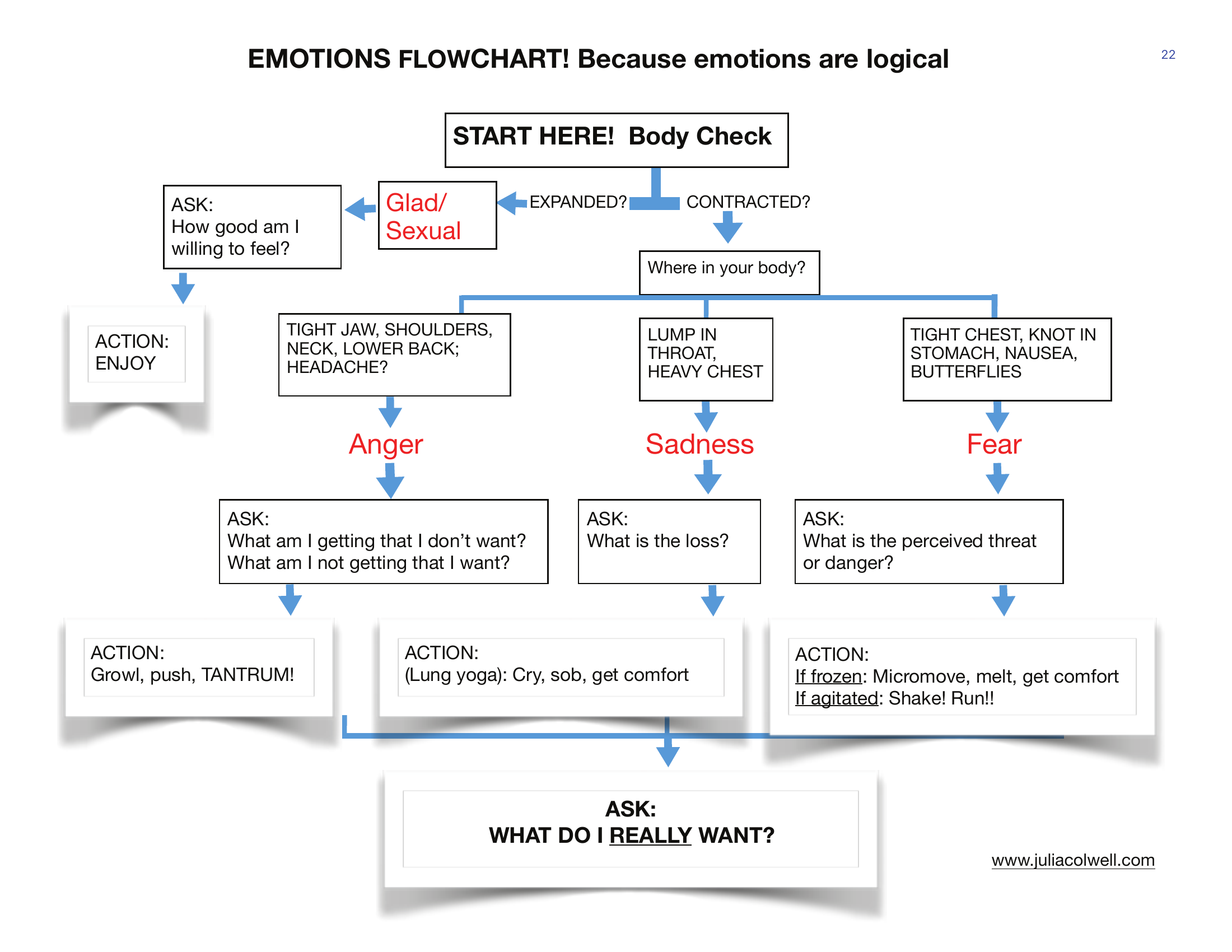
The Emotions Flowchart. “Because emotions are logical.” A decision tree from body check to action — starting with expanded or contracted, then locating where in the body, identifying the emotion, asking the matching question, and choosing the action:
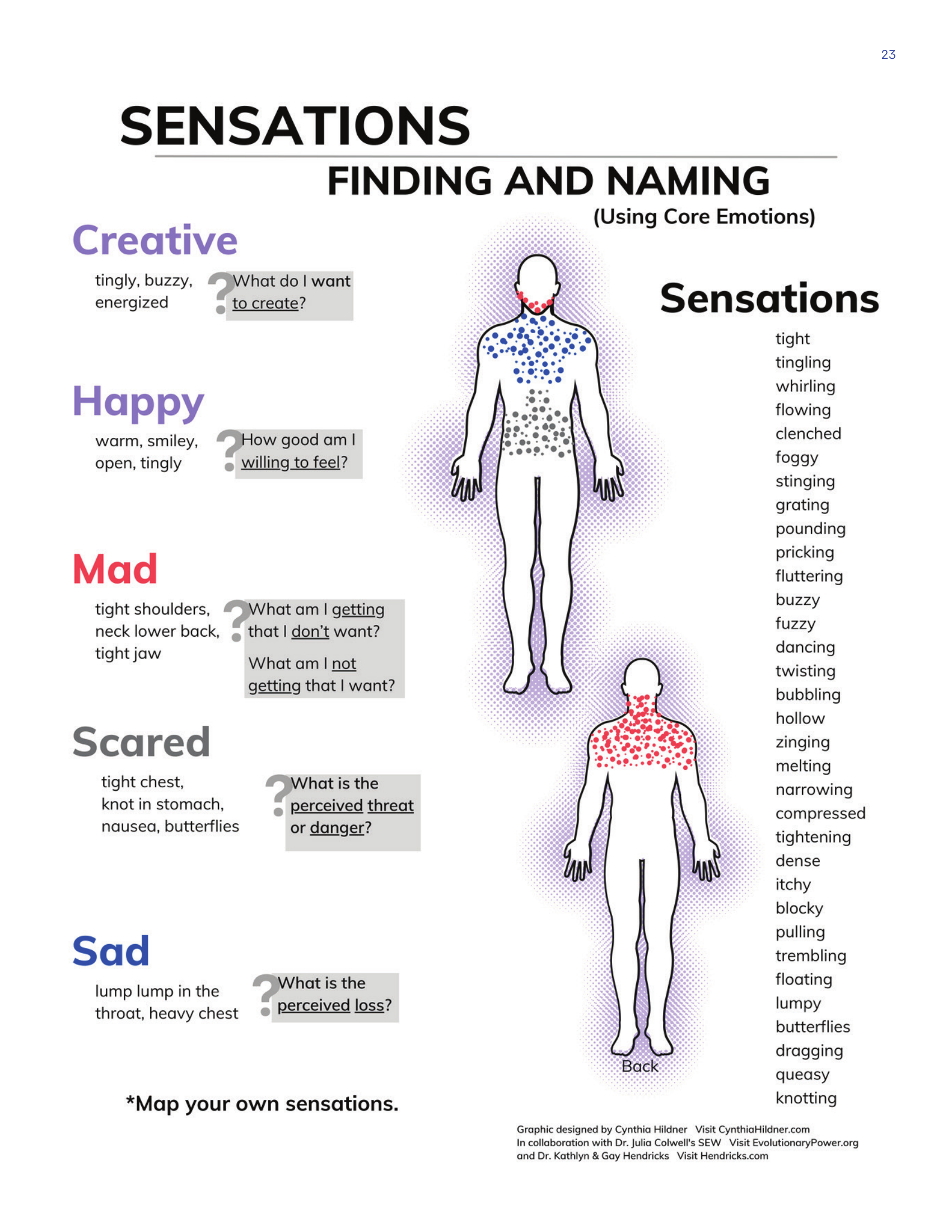
The Sensations Body Map. Cynthia Hildner’s body diagram — where each of the five core emotions lives in the body, with a sensation vocabulary list:
Practiced contexts
- Solo. A daily move and an in-the-moment one.
- In dyads. Two people walking each other through SEW out loud. Coaching language: “I invite you…” / “Are you willing to…?”
- In a group. The shared form a meeting can hold (see meeting-script).
- In the Guide–Traveler form (see guide-traveler-companion).
Facets served
- facet-translating-body-wisdom — the S of SEW is the direct practice of this facet, and the whole move sits inside it.
Related principles
- principle-2 — translating the body’s wisdom as the core mechanism. SEW is the operational form of Principle 2.
- principle-3 — the practice as presencing via SEW.
Containers it lives in
Solitary practice; the open meeting; the Guide–Traveler relationship; the Safe Harbor opening as the move the container is opening for.
Related tools
- full-body-yes-no — depth practice of the W.
- emotional-cycles — the shape of the arc inside the E.
- experiencing-your-feelings — depth practice of staying with the E until the cycle completes.
- sourcing-your-own-safety — what makes it possible to stay through intense activation without leaving the body.
Source and attribution
Primary sources:
raw/The Colwell Practice Immersion Manual-v3 with cover.pdf, Section I (Emotional Triggers: Getting to the bottom line through S.E.W.), pp. 15-17 (prose) and pp. 21-23 (the canonical handouts).raw/2025 ILC Version AT Master Curriculum.docx.md, Week 2 (SE-) and Week 3 (SEW: Knowing What You Want / Don’t Want).raw/EPI_Expansion_Strategy_v5.docx.md— “Sensation interrupts story. Emotion interrupts defense. Want restores agency.” Retained because it compresses the entire move into one line.
Visual handouts:
/assets/colwell-sew-handout-021.png— the SEW one-page reference (May 2023)./assets/colwell-emotions-flowchart-022.png— the Emotions Flowchart decision tree./assets/colwell-sensations-body-map-023.png— the Sensations Body Map (Cynthia Hildner, in collaboration with Julie Colwell and the Hendrickses).
Lineage: Gay & Kathlyn Hendricks. The current canonical SEW handout is by Julie Colwell (May 2023).
Status notes
canonical — substantially expanded 2026-05-25 from the Colwell
Practice Immersion Manual v3 (Section I). The Law (“Anyone gets
to feel anything, for any reason”) and the three visual handouts
were added in this pass. The 2026-05-24 ILC rewrite established the
page in canonical form.