Personas
What it is
A framework — and a practiced relationship — for the parts of the self that exist to avoid feeling feelings. Personas are the masks the practitioner wears (and was trained to wear, often by watching others wear them as a child) as defenses against the primary emotions of mad, sad, glad, scared, and sexual/creative.
The functional definition, repeated across both source materials: the whole function of personas is to not have feelings. If a practitioner is acting from a persona, by definition they are routing around a feeling that did not get felt.
We refer to personas as the “masks” we wear — roles we unconsciously take on in response to our environment. These masks are shaped by the people we grow up around, the expectations placed on us, and the emotional dynamics we absorb. They are not random; they are intelligent, adaptive responses designed to help us navigate a world that we felt emotionally overwhelmed by. — Manual v3, p. 44
The arc the persona lives inside
Essence → Feelings → Persona → Projection. This four-stage chain is the canonical map of how anyone moves from their true self into a defended reality.
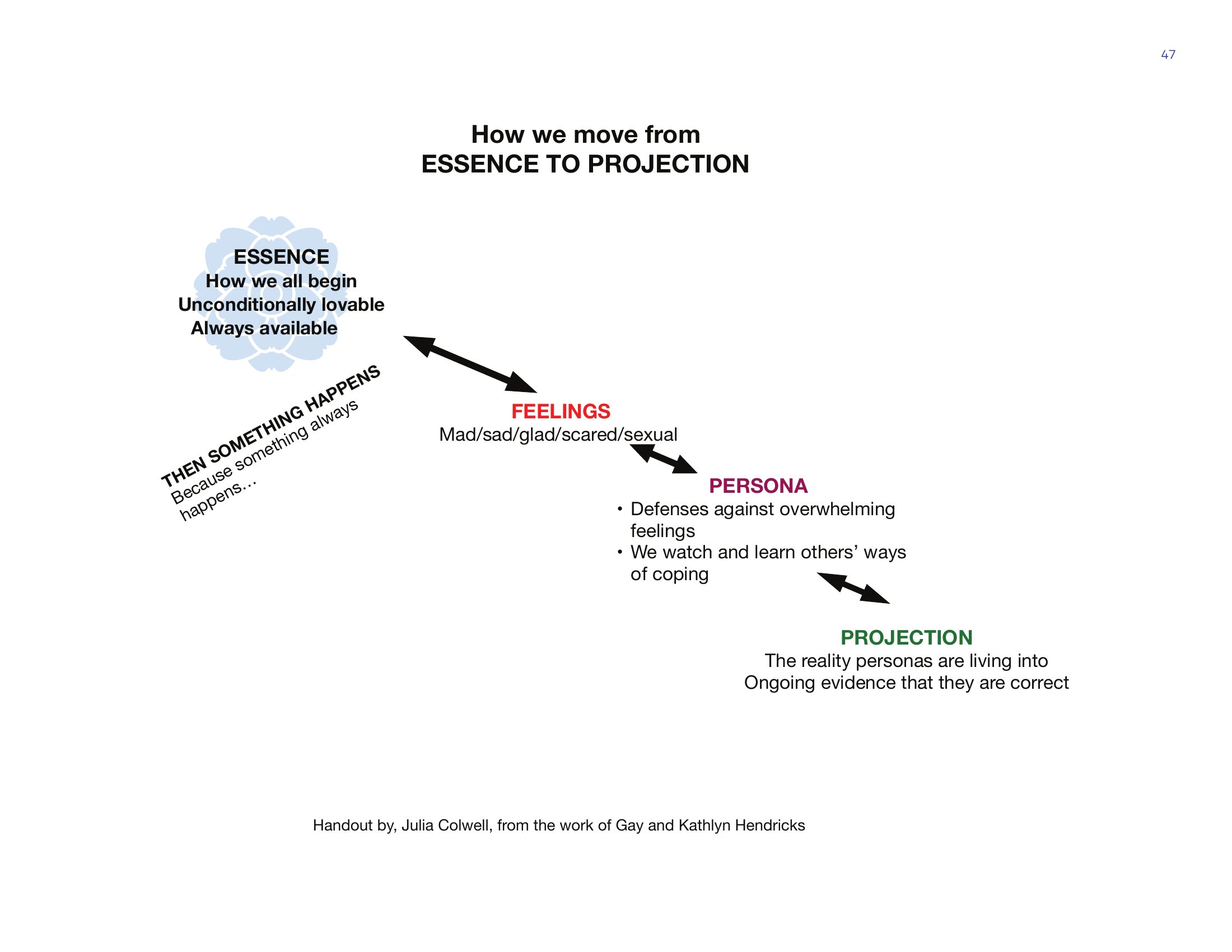
(See projection-work for the fourth stage.)
- Everyone starts from essence — true nature.
- Then “something happens” — the inevitable. The 3D world is full of things, most of which roll off, but the ones that hit an old pattern surface an emotion.
- If the practitioner allows the feeling cycle to complete (mad / sad / glad / scared), they return directly to essence. No persona needed.
- If they do not — usually because the feeling was unsafe to feel at some earlier time — they enter a persona.
What personas are
- Masks worn to protect against feeling. All defense, no actual agency. Even when a persona looks like it is having a feeling, that is smokescreen emotion, not the primary emotion underneath.
- Patterned after how the practitioner saw feelings handled. Often by parents or early caregivers, often by the broader culture’s permission and prohibition around emotion.
- All Reactive Brain. Every persona lives in Reactive Brain (see inner-map).
- Classifiable as Victim / Villain / Hero. Persona families align with the karpman-triangle positions.
- Distinct from essence. A practitioner’s persona is not who they are. One of the most common confusions is identifying with one’s defenses and never meeting one’s actual self.
The curriculum names many ordinary psychological phenomena as persona work: addictions, anxiety, depression, self-harming impulses, harming impulses, even racism and other -isms. The lens is consistent — these are sustained patterns for not having a particular feeling.
Three categories of persona — Victim / Villain / Hero
Personas sort into three families on the karpman-triangle:
-
Victim personas — found at the immobilized, Power Under levels of Shame, Guilt, Despair, Sadness, Frozen Fear. Those who “feel” collapsed, powerless, overwhelmed, or wronged. (Examples from the canonical persona cards on p. 63: Complainer, Worry Wart, Unappreciated Genius, Martyr, Resigned, The Needy One, The Reliable One, Whiner, Depressed, Dummy, Lynchpin — 17 total.)
-
Villain personas — found at the mobilized Power Over levels of Agitated Fear, Anger, and Pride. Those who “feel” angry or vengeful, and attack, control, or dominate. (Examples from p. 64: Critic, Rebel, Cynic, Debater, Control Freak, Gossip, Bulldozer, Drill Sargeant, Mr. Sarcasm, Know-It-All, Narcissist — 16 total.)
-
Hero personas — found at the mobilized Power Over levels of Agitated Fear and Pride. Those who “feel” compelled to rescue, fix, or save. (Examples from p. 65: Protector, Peacemaker, Energizer Bunny, Firefighter, Cheerleader, Peter Pan, Supercompetent, Multitasker, Provider, Good Parent, Nice Guy — 17 total.)
Each persona has its own what it says and what it requires — the need it has of the world to keep playing its role. The three canonical persona cards:
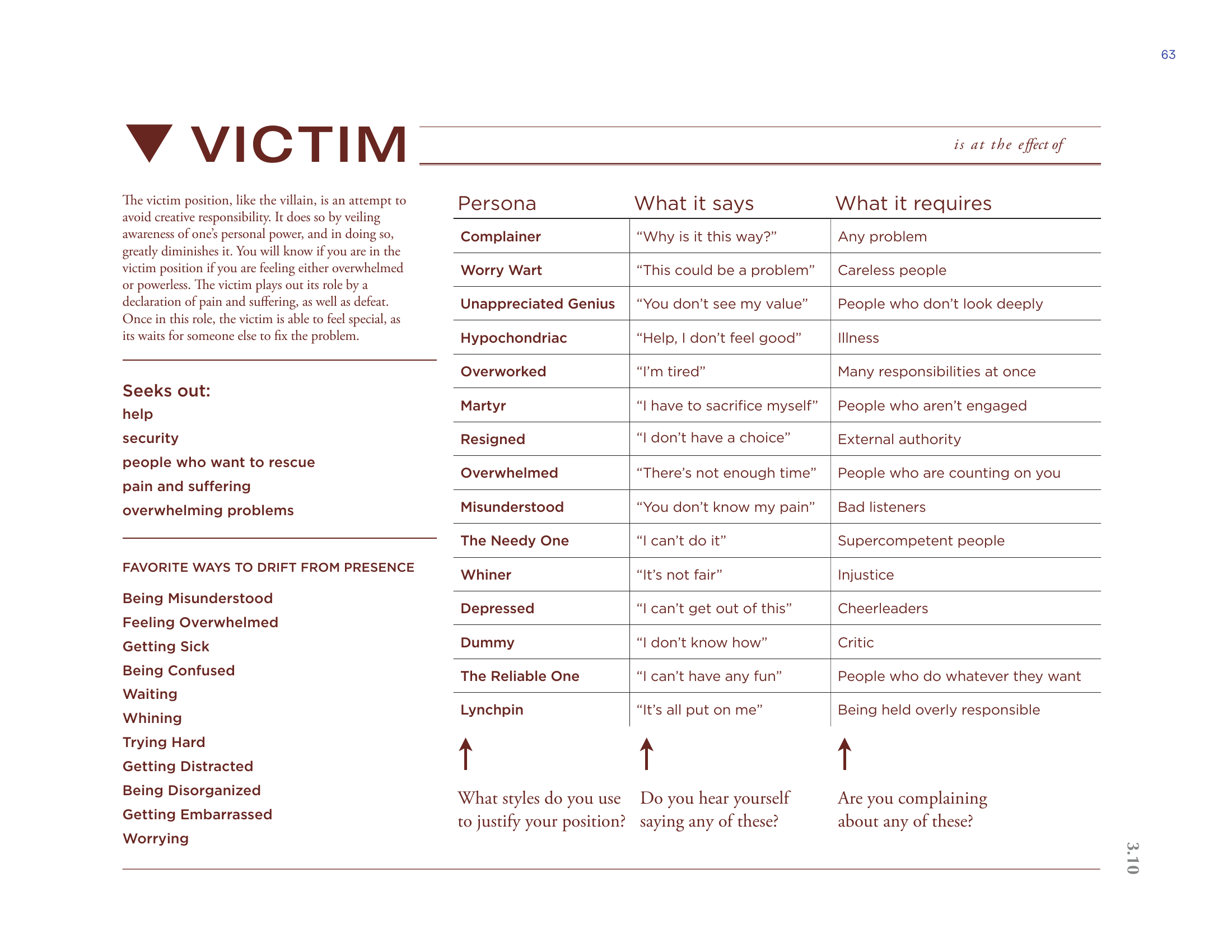
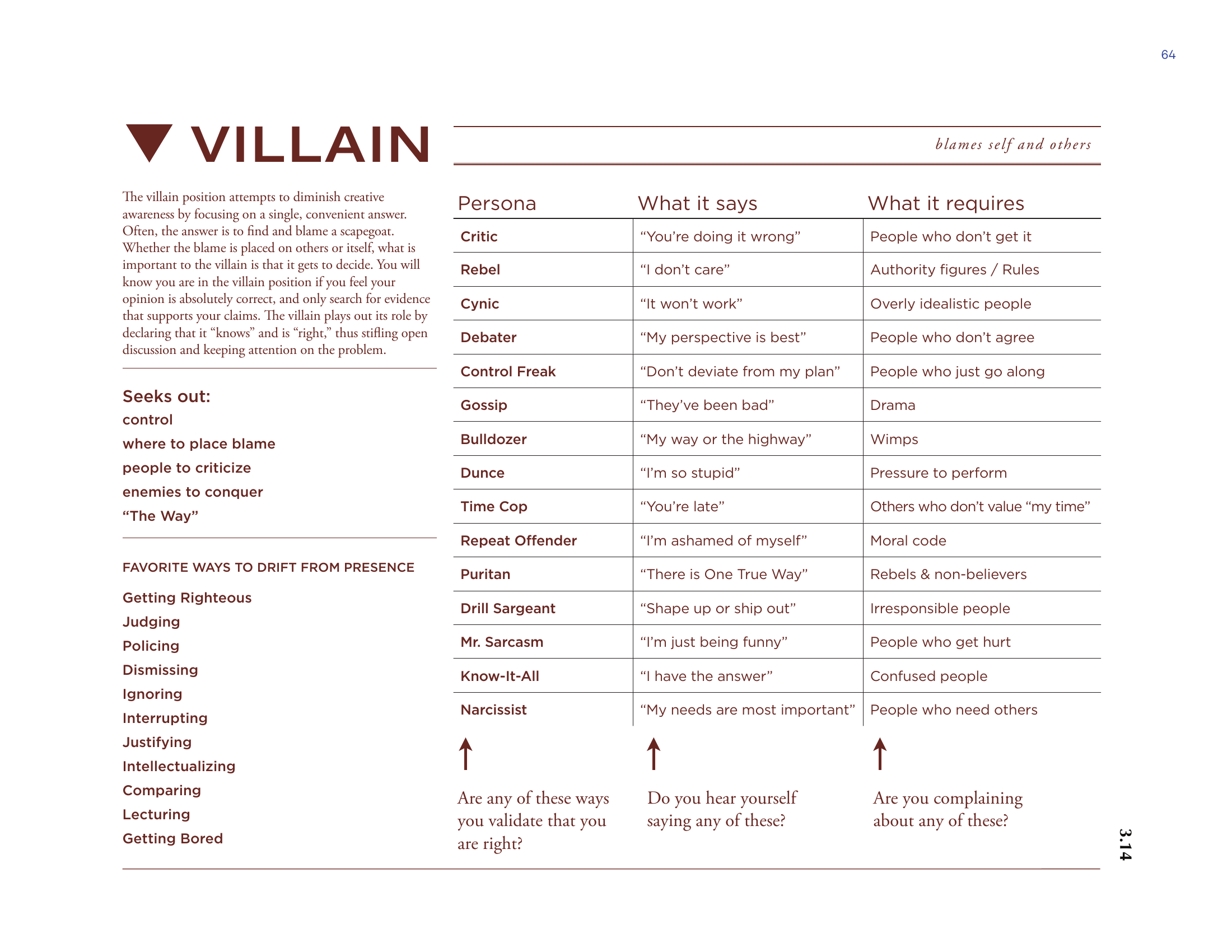
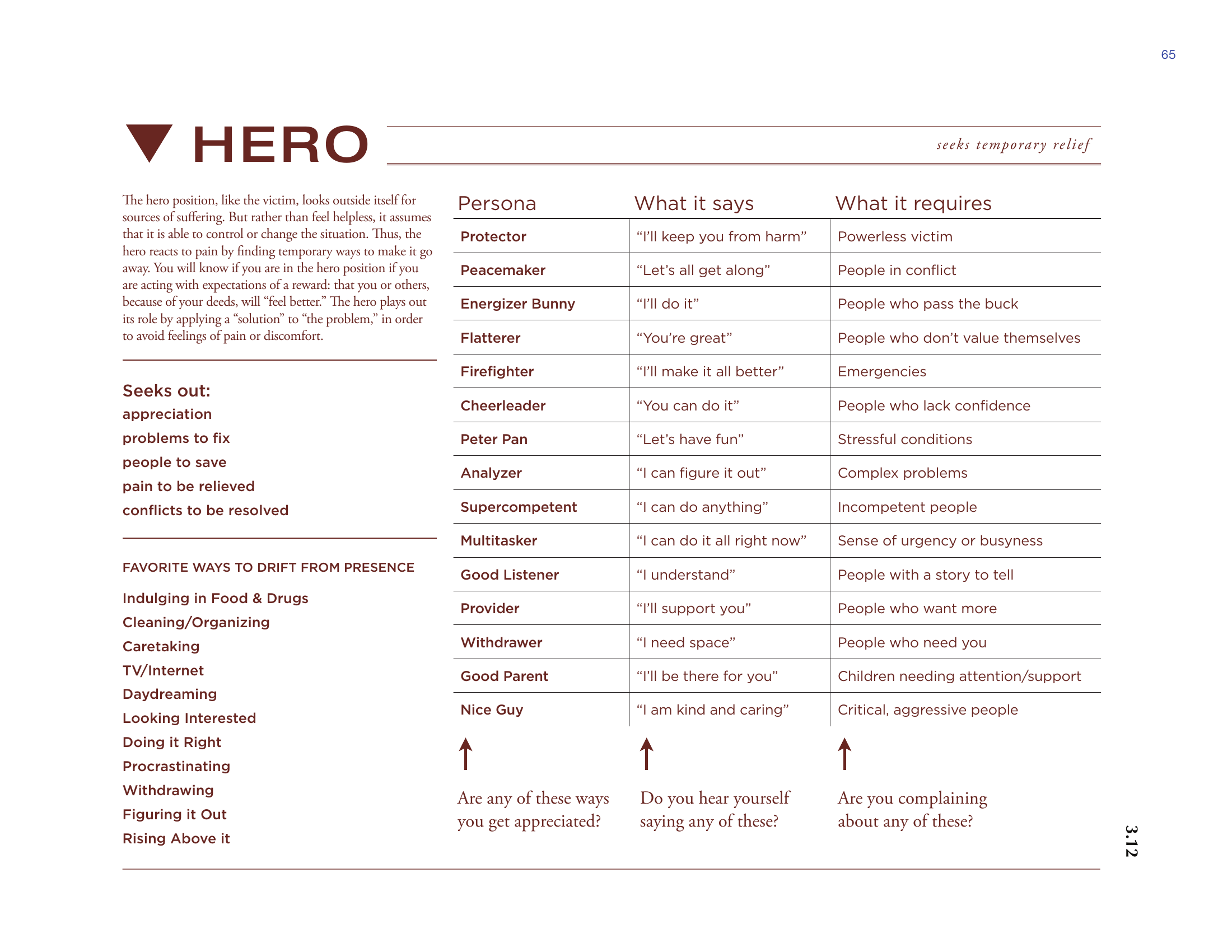
Each card also lists Favorite ways to drift from presence — the characteristic behaviors that signal which persona is running. Useful for self-recognition.
Persona Mapping — how personas interlock
In relationship, personas don’t just appear individually — they interlock. Person A’s persona elicits a particular persona from Person B, which elicits the next persona from Person A, and so on through an escalating chain.
The manual’s Persona Mapping sample (p. 51) shows the chain explicitly — something happens triggers the personas, and the chain begins:
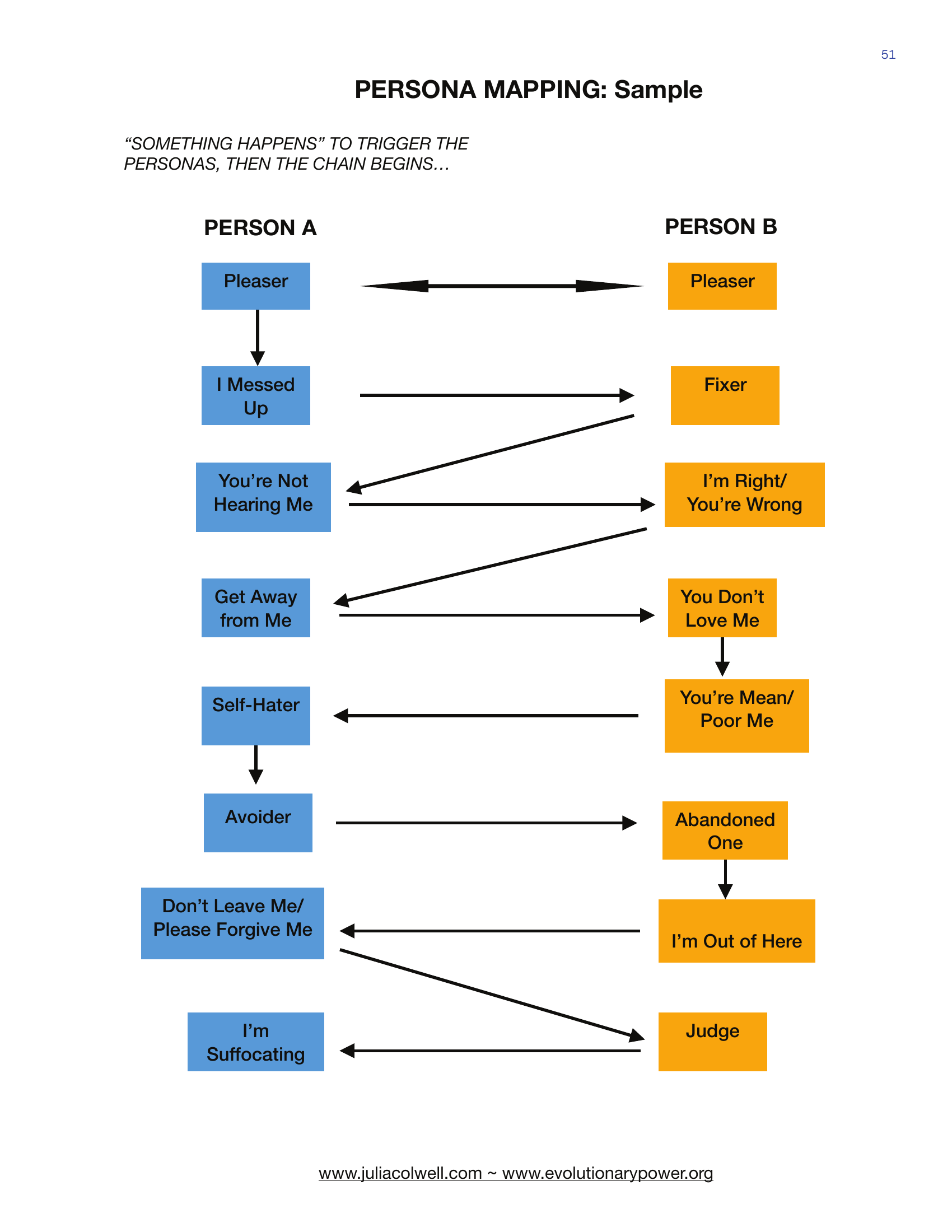
A practitioner can map their own interlocks: with a partner, parent, boss, child. Naming the chain is itself a shift — the practitioner sees the system they were participating in, not just the moment they got triggered. From there, the practice is to interrupt the chain by shifting one’s own physiology (see sew, power-with-over-under).
How to relate to personas
The practice is not to defeat or get rid of personas. It is to meet, accept, and love every persona the practitioner finds.
- What we resist persists.
- What we have relationship with we can influence.
That is why the dedicated tool is the persona interview — a respectful conversation with the persona itself, treating it as a part of the self with its own logic, history, and needs. As the practitioner relates to the persona, the persona becomes workable.
How personas project on the world
A persona wears a particular filter. While inside the persona, the practitioner:
- sees the world through that persona’s filters;
- energetically draws in responses that confirm the persona — responses that both support its defense (the not-feeling) and validate its existence;
- “ends up living in a world of projection but totally believes themselves.”
This is why personas and projections must be worked together. See projection-work.
What does this persona require?
A useful next move once a persona has been identified: ask what it requires of the world to keep doing its job. Most personas have a specific need — to be needed, to be admired, to be safe, to be unseen — and they recruit relationships that meet that requirement.
Two related observations from the curriculum:
- What we complain about is what we require. The recurring complaint is a clue to the requirement.
- Persona interlocks. In relationships, personas often slot into each other’s requirements. If a partner does not have the right persona, the practitioner will often mold them into the matching responses, deeply unconsciously.
This is delicate work. It needs time, space, love, and acceptance to surface — not insight delivered too fast.
The move
-
Notice you are in a persona. Body cue: a sense of performing, defending, or recruiting. The feeling-arc is not running.
-
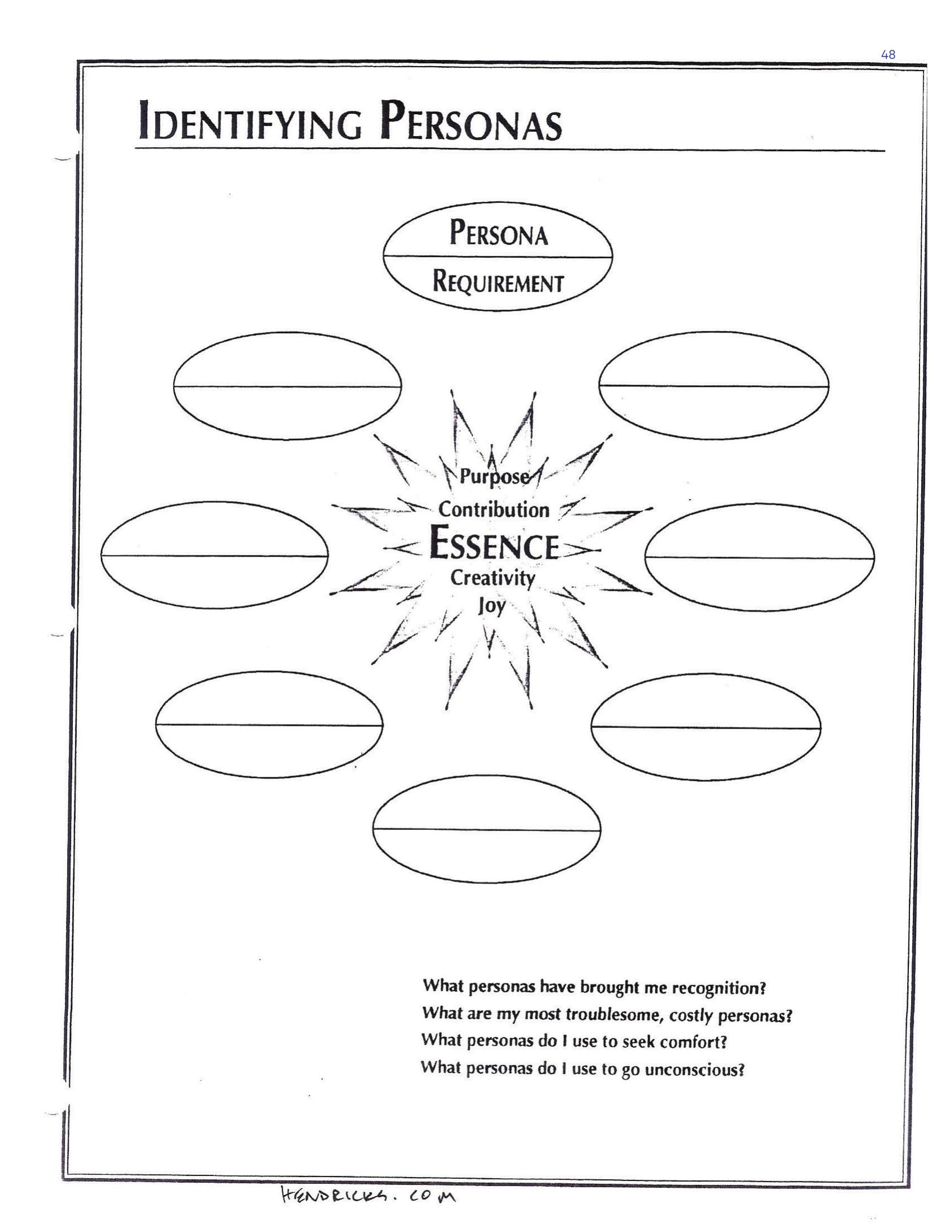
Name the persona. Many practitioners build a chart of their personas over time; the canonical Identifying Personas worksheet is a starting point with prompts: What personas have brought me recognition? What are my most troublesome, costly personas? What personas do I use to seek comfort? What personas do I use to go unconscious? Naming is itself a shift; naming reduces identification.
-
Run a persona interview. Meet the persona on its own terms. What does it want? What feeling is it avoiding? What does it require of the world?
-
Find the feeling underneath. Run sew through to the primary emotion the persona is keeping at bay. Let the cycle complete (see experiencing-your-feelings).
-
Return to essence. Essence is what is present once the feeling has moved and the persona is no longer needed in the moment.
Why this matters
Emotions are powerful enough that the practitioner often holds unconscious fears about feeling them: I’ll go crazy. I’ll explode. I’ll be rejected by those who love me. The persona is the elegant solution to those fears — at the cost of essence. Persona work is what restores essence access without losing the safety the persona was protecting.
Facets served
- facet-navigating-inner-world — personas are the primary terrain of this facet.
- facet-aligning-with-essence — essence is what becomes available when the persona is met and the feeling has moved.
Related principles
- principle-2, principle-3 — SEW is how feeling is reached underneath the persona.
- principle-19 — group is not therapy. Persona work is the practitioner’s; the group holds the form, it does not pathologize the persona.
Related tools
- persona-interviews — the dedicated practice for working with a named persona.
- persona-to-essence — the depth move from persona to the essence underneath.
- projection-work — what a persona does in the world.
- karpman-triangle — persona families map to triangle positions.
- inner-map — all personas live below the Bridge; meeting them is what makes crossing available.
Source and attribution
Primary sources:
raw/The Colwell Practice Immersion Manual-v3 with cover.pdf, Section III (From Projection to Essence: Uncovering the True Self), pp. 44-46 (the canonical prose on personas) and the persona cards on pp. 63-65 (Victim, Villain, Hero).raw/2025 ILC Version AT Master Curriculum.docx.md, Weeks 10 and 11 (Navigating Your Inner World — Personas I, Personas and Projection).
Visual handouts:
/assets/colwell-essence-to-projection-047.png— the four-stage Essence → Feelings → Persona → Projection diagram./assets/colwell-identifying-personas-048.png— the persona worksheet (Hendricks lineage)./assets/colwell-persona-mapping-sample-051.png— the persona interlock sample./assets/colwell-victim-villain-hero-personas-063.pngthrough065.png— the canonical Victim/Villain/Hero persona cards.
Lineage: Julia Colwell, PhD. The persona framework comes from the broader Hendricks lineage (Gay & Kathlyn Hendricks).
Status notes
canonical — substantially expanded 2026-05-25 from the Colwell
Practice Immersion Manual v3 (Section III + Section IV persona
cards). The three-category breakdown (Victim/Villain/Hero) and
Persona Mapping interlock were added in this pass. The 2026-05-24
ILC ingest established the page; the manual ingest fills in the
visual handouts and the canonical persona vocabulary.