Essence Interview
What it is
An interview with one’s own essence — the part of the practitioner that is essence, not persona. Done in the body, in essence’s posture, in essence’s voice.
This is the second half of the persona-to-essence interview, filed as its own tool because it is also done standalone — without first interviewing a persona — when the practitioner wants to deepen their relationship with essence directly.
What essence is
Essence is our true self. It is who we are at our core — before the masks, before the defenses, before the world taught us how to survive. Essence is the energy we came into this life with. It’s untouched by trauma, unburdened by roles, and connected to something far greater than the individual self. — Manual v3, p. 46
Essence lives in Creative Brain. Each practitioner has their own distinct flavor of essence — and that flavor expresses through them in everything they do, when they are living from Creative Brain.
We don’t “find” our essence. We remember it. We return to it. And we can cultivate that return through conscious practice. — Manual v3, p. 46
The Essence Interview is one of the most direct practices for that return.
The move
Have the practitioner choose a name for their essence and step into it — assume essence’s posture, breathe essence’s breath. Then ask essence the following questions:
- _____, what’s the most important thing to you?
- _____, when did you make your first appearance?
- _____, from whom did you learn this possibility?
- _____, how do you support yourself to fully feel your feelings?
- _____, what are the most important ways you come home to ease and flow?
- _____, what would be some ways for you to express who you really are?
- _____, what is the new story you want to live into?
- _____, what support can you create for living into this new story?
If a persona was interviewed first (the full persona-to-essence interview), close with:
- _____, what would you like to say to the persona (above) who believes the old story?
When to use it
- As the second half of persona-to-essence.
- Standalone, when the practitioner wants direct contact with essence — especially after a long stretch in Reactive Brain.
- When writing a manifesto — the manifesto’s “name of your essence” component comes from this interview.
- When essence has been forgotten — when the practitioner has been living from personas for a while and wants to remember.
Why this works
The body remembers what essence’s posture is. Stepping into essence physically — feet, breath, voice, weight — is faster than talking about it. The questions then ask essence to speak for itself, in first person, from the body.
The questions are invitations to remember, not assignments. When did you make your first appearance? is not literal autobiography — it is essence pointing to a moment when it was present. From whom did you learn this possibility? is essence naming its lineage.
The handout
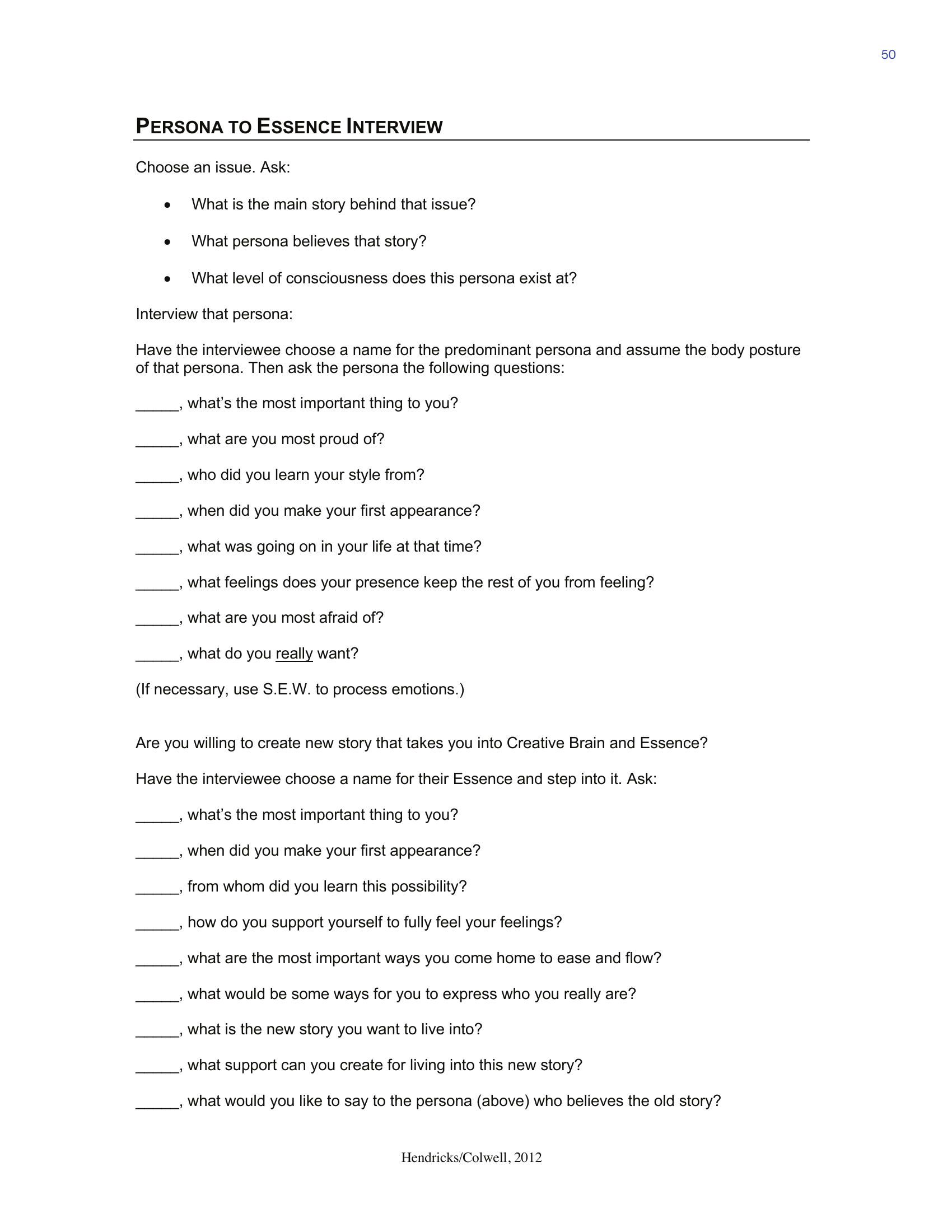
The Essence Interview lives on the bottom half of the canonical Persona to Essence Interview handout:
Facets served
- facet-aligning-with-essence — primary. The interview is essence work in its most direct form.
- facet-navigating-inner-world — essence is on the Inner Map; this is the navigation tool for the upper register.
Related principles
- principle-5 — share experience, not advice. The interviewer asks only questions; essence does the speaking.
Related tools
- personas, persona-interviews — the companion practices. Knowing personas well makes essence easier to distinguish.
- persona-to-essence — the full two-part form; this tool is the essence half.
- manifesto — the long-form, written version of what essence speaks during the interview.
- inner-map — essence lives in Creative Brain (above the Bridge). The map shows the territory.
Source and attribution
Primary source:
raw/The Colwell Practice Immersion Manual-v3 with cover.pdf, Section III (From Projection to Essence), p. 50. The Essence Interview is the second half of the Persona to Essence Interview handout.
Visual handout:
/assets/colwell-persona-to-essence-interview-050.png— the same handout that holds persona-to-essence.
Lineage: Hendricks/Colwell, 2012 (per the handout footer).
Status notes
canonical — promoted from needs-export 2026-05-25 from the
Colwell Practice Immersion Manual v3 (p. 50). Filed separately
from persona-to-essence because the essence half is a complete
practice on its own — useful for practitioners who already know
their predominant persona and want to deepen contact with essence
directly.