Karpman Triangle (Victim / Villain / Hero)
What it is
A diagnostic and a release tool. The Karpman Drama Triangle is the anatomy of any power struggle — three positions that practitioners unconsciously rotate through inside conflict. Recognizing the position is the first step in stepping out of it.
The three positions, in EPI’s working vocabulary (Hendricks’s relabel of Karpman’s original Victim/Persecutor/Rescuer):
| Position | Mode | Underneath |
|---|---|---|
| Victim | immobilized | anger, creativity, sexuality (frozen) |
| Villain | mobilized | fear, sadness |
| Hero | mobilized | fear, sadness |
All three are Reactive Brain. All three are anchored in blame — self, other, or both. Movement around the triangle (Victim becomes Villain becomes Hero becomes Victim) feels like motion but is still Reactive Brain — just rotating. The actual move is off the triangle into Creative Brain. (See inner-map.)
⚠️ Load-bearing point preserved. “Victim is Power Down” does not mean powerless. Resistance can stop Power Over; Victim is often in charge of the whole triangle through its resistance. Power Over does not imply real power — real power is outside the triangle, in Creative Brain, where everybody can get everything they want.
The three position cards
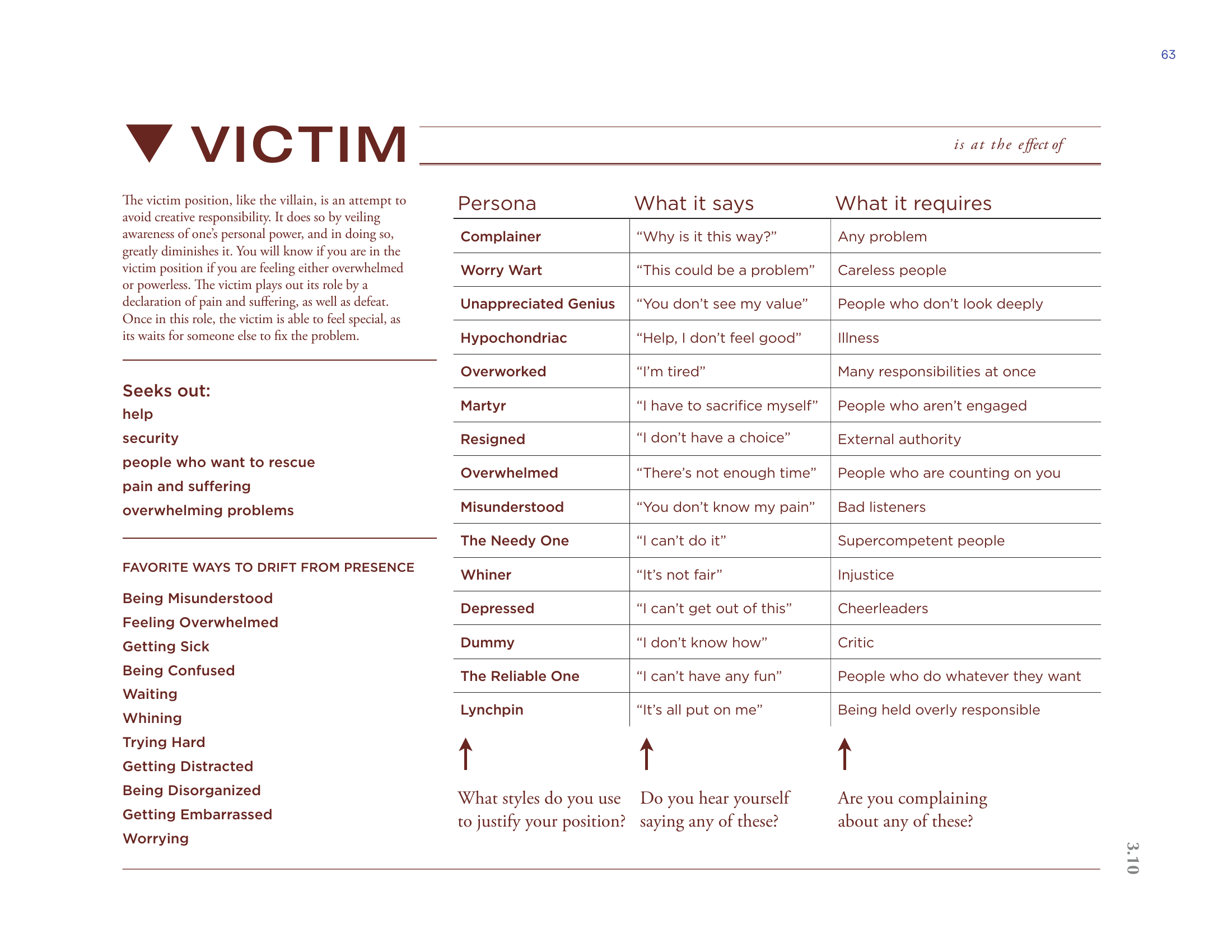
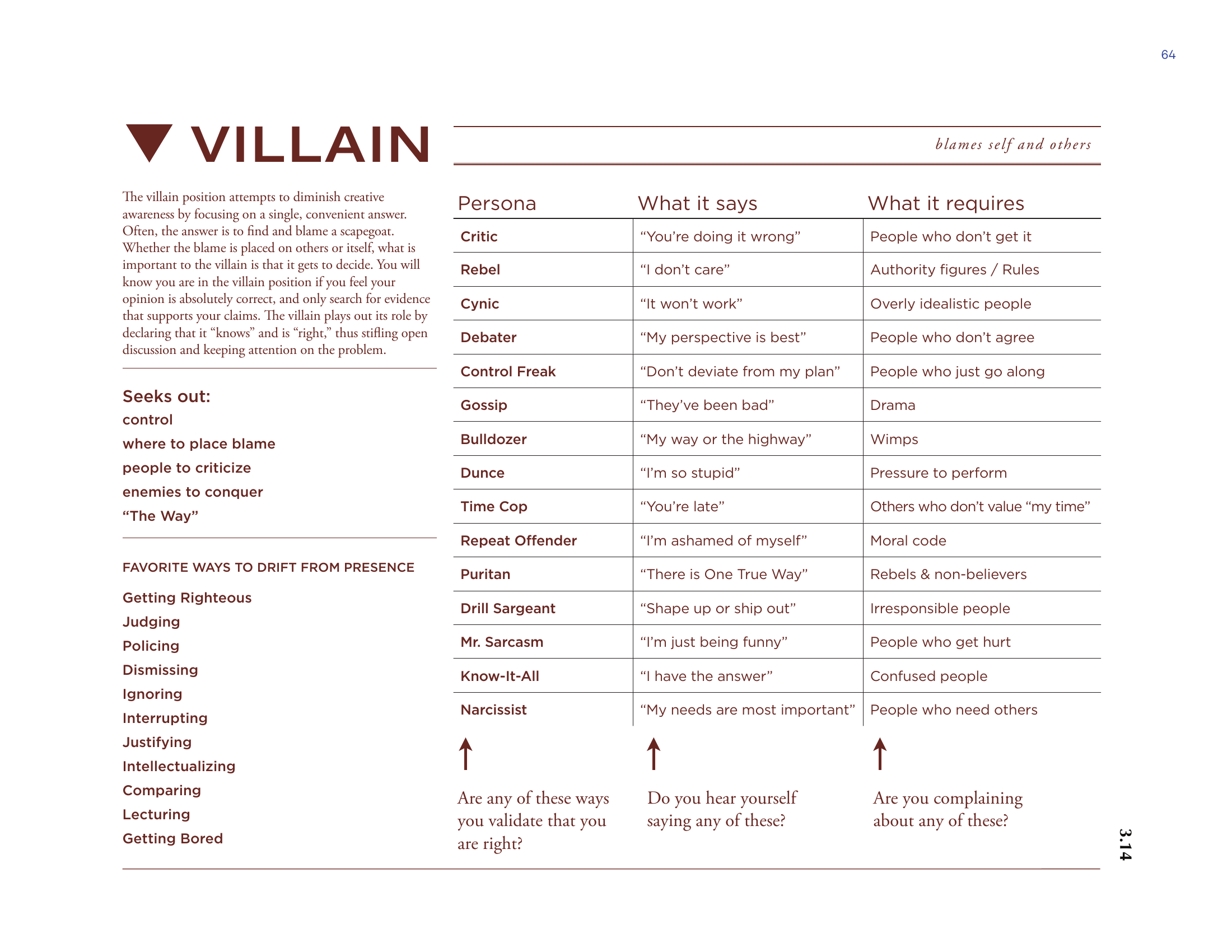
The manual provides three canonical reference cards — one per position — listing the personas, what each says, what each requires, what each seeks out, and the favorite ways each drifts from presence.
Victim — “is at the effect of.” 17 named victim personas. Seeks: help, security, people who want to rescue, pain and suffering, overwhelming problems. Sample personas: Complainer, Worry Wart, Unappreciated Genius, Martyr, The Needy One, Whiner.
Villain — “blames self and others.” 16 named villain personas. Seeks: control, where to place blame, people to criticize, enemies to conquer, “The Way.” Sample personas: Critic, Rebel, Cynic, Control Freak, Bulldozer, Drill Sargeant.
Hero — “seeks temporary relief.” 17 named hero personas. Seeks: appreciation, problems to fix, people to save, pain to be relieved, conflicts to be resolved. Sample personas: Protector, Peacemaker, Energizer Bunny, Firefighter, Cheerleader, Supercompetent.
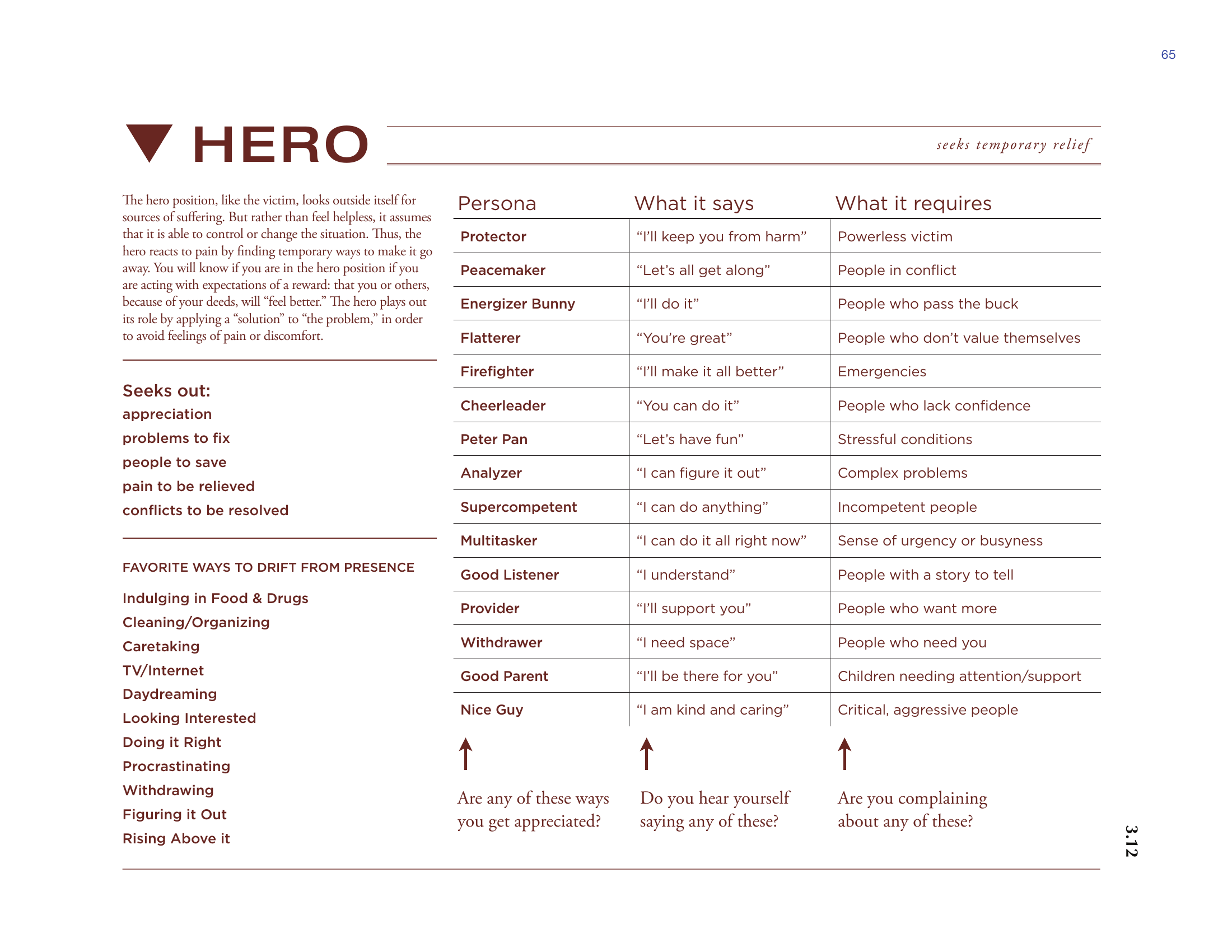
Each card also lists Favorite ways to drift from presence — the characteristic behaviors that signal which position is running. “Are any of these ways you get appreciated? Are you complaining about any of these?”
The two practices
I. Recognize where you are
- Bring up a current charged issue.
- Notice the position. Am I Victim — this is being done to me? Villain — they are the problem and I am justified? Hero — I will rescue / fix / save?
- Move deliberately around the triangle, voicing the favorite thoughts from each point. Hear how each position recruits you. Notice that moving from one position to another doesn’t change the underlying register — it is all still Reactive Brain.
II. Get out of the triangle
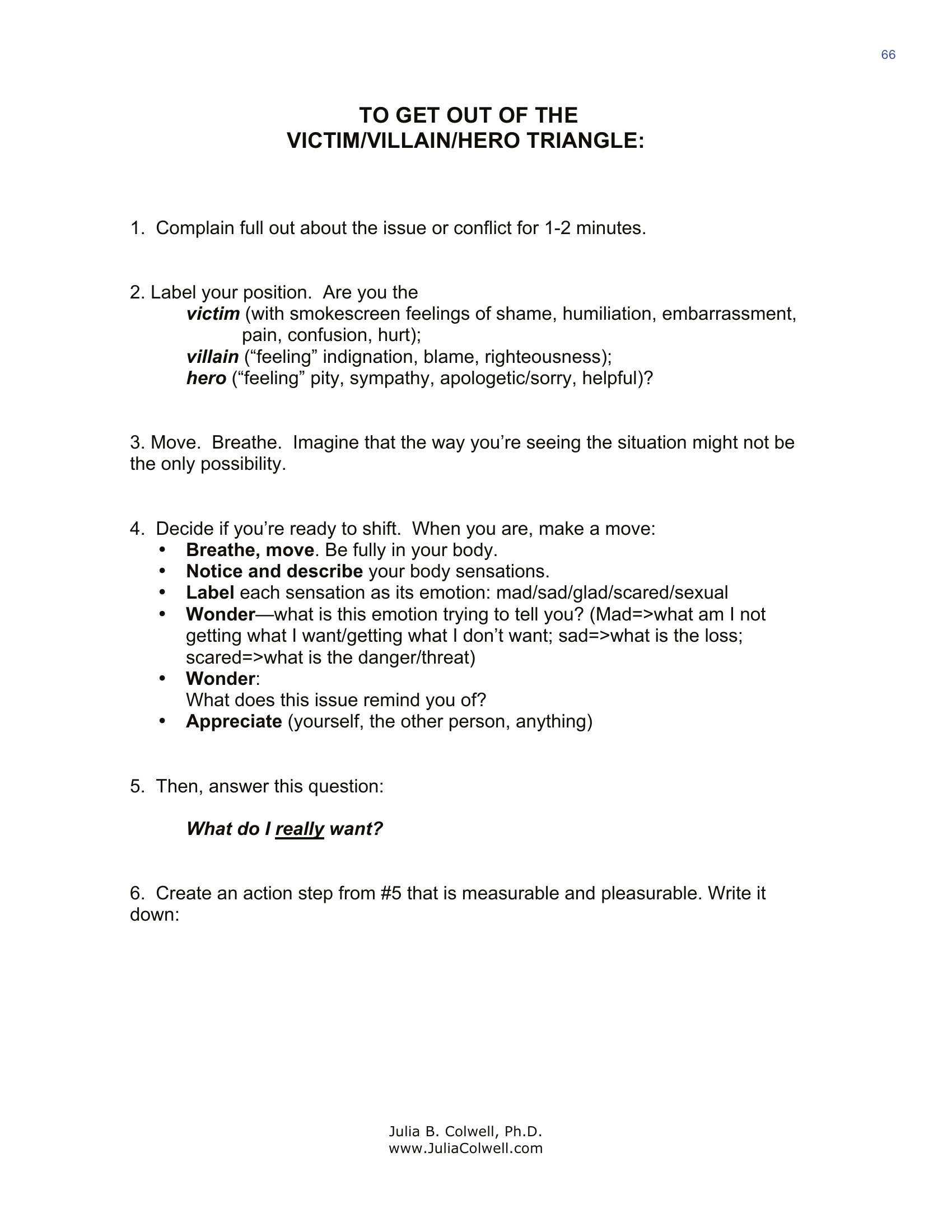
The canonical six-step move (Julie Colwell, Manual v3, p. 66):
-
Complain full out about the issue or conflict for 1-2 minutes.
-
Label your position. Are you the:
- Victim (with smokescreen feelings of shame, humiliation, embarrassment, pain, confusion, hurt);
- Villain (“feeling” indignation, blame, righteousness);
- Hero (“feeling” pity, sympathy, apologetic/sorry, helpful)?
-
Move. Breathe. Imagine that the way you’re seeing the situation might not be the only possibility.
-
Decide if you’re ready to shift. When you are, make the move:
- Breathe, move. Be fully in your body.
- Notice and describe your body sensations.
- Label each sensation as its emotion: mad/sad/glad/scared/sexual.
- Wonder — what is this emotion trying to tell you? (Mad ⇒ what am I not getting that I want or getting that I don’t want; sad ⇒ what is the loss; scared ⇒ what is the danger/threat.)
- Wonder — what does this issue remind you of?
- Appreciate (yourself, the other person, anything).
-
Answer this question: What do I really want?
-
Create an action step from #5 that is measurable and pleasurable. Write it down.
The underlying principles (preserved from Hendricks lineage and prior wiki content):
- Know you are in it. No shift is possible without recognition.
- Be willing to shift. Do not shift until you are willing. Premature shifts collapse back into the triangle, often into a different position. Genuine willingness is the prerequisite.
- Move from blame to 100% responsibility. Each triangle position is a distortion of 100% responsibility — Victim is less than 100% (it is all happening to me), Hero is more than 100% (I am responsible for them), Villain is mixed (fed by Victim consciousness while acting controlling). 100% responsibility = 100% power.
- Sometimes the move is to go bigger before shifting. Forcing the shift before it is genuine is itself a triangle move (often a Hero move on oneself). Doing the position more — feeling all the way into the Victim, all the way into the Villain — can be what allows it to complete and release.
Why this matters
- Each position loses power because it orients the practitioner outside themselves, where they have no agency.
- Blame is what keeps the triangle intact — blame of self, blame of other, blame of circumstance.
- Hierarchy lives in the triangle: Hero and Villain are Power Over / dominance; Victim is Power Under / submission. (See power-with-over-under.) Hierarchy implies disconnection.
- The triangle is contagious. One person’s Victim recruits another’s Hero or Villain almost involuntarily. This is why drama and melodrama are compelling — they invite the nervous system into a familiar pattern.
- “Who is the biggest victim?” is at the heart of almost any sustained power struggle. Naming this in oneself is part of the move out.
Cultural notes from the curriculum
- Stories in media run on the triangle and the adrenaline it produces. Engaging those stories is a reliable way to enter the triangle.
- The Hero ethos is strong in the culture — but to have a Hero you must have a Victim and a Villain. Heroism imports the whole triangle.
- “Romance of the rescue” (Caroline Myss): many relationships begin inside the Hero/Victim pairing.
- Victim consciousness is endemic. The curriculum references a Victim Questionnaire (Ethel Greene) — needs-export as a separate handout when the team is ready.
Coaching another out of the triangle
The curriculum names this as a distinct skill — Coaching Another to Get Out of the Triangle — held in a separate handout that is needs-export. The shape is the same as I above: locate the position with them, ask after willingness, support 100% responsibility, run SEW. Do not try to lift someone out before they are willing; that is a Hero move and re-enters the triangle on the coach’s side.
Facets served
- facet-discovering-true-power — the triangle is the failure mode this facet is naming the way out of.
- facet-navigating-inner-world — the personas that hold the positions are the territory of this facet. (See personas.)
- facet-getting-unstuck — most stuckness has triangle shape.
Related principles
- principle-2, principle-3 — SEW is the move out of any triangle position.
- principle-6 — the form does the work; the triangle is what happens when individual willpower tries to substitute for the form.
Related tools
- inner-map — the orientation reference; the triangle lives in Reactive Brain, Creative Brain is what is on the other side of the Bridge.
- power-with-over-under — Power Over / Power Under are the triangle’s power axis named directly.
- sew — the move-out move, run from inside oneself rather than inside the triangle.
- personas — Victim / Villain / Hero are persona families.
- four-pillars-of-integrity — 100% responsibility is one of the pillars; it is also the practitioner’s move off the triangle.
Source and attribution
Primary sources:
raw/The Colwell Practice Immersion Manual-v3 with cover.pdf, Section IV (Evolutionary Power: Moving Out of the Karpman Drama Triangle), pp. 57-67 (prose), pp. 63-65 (persona cards), p. 66 (the canonical six-step Get Out of the Triangle handout).raw/2025 ILC Version AT Master Curriculum.docx.md, Weeks 8 and 9.
Visual handouts:
/assets/colwell-victim-villain-hero-personas-063.pngthrough065.png— the three position cards./assets/colwell-to-get-out-of-triangle-066.png— the six-step exit process.
Lineage:
- Stephen Karpman, MD — The Drama Triangle (1968). Original labels Victim / Persecutor / Rescuer.
- Gay & Kathlyn Hendricks — relabel Victim / Villain / Hero; the framing EPI works with.
- Julia Colwell, PhD — authored the three canonical persona cards and the six-step exit handout.
- Kucsan / Colwell alternative naming Genie (Hero) / Meanie (Villain) / Weenie (Victim) preserved in the ILC curriculum for color.
Status notes
canonical — substantially expanded 2026-05-25 from the Colwell
Practice Immersion Manual v3 (Section IV). The canonical persona
cards and the six-step exit handout were added in this pass. The
2026-05-24 ILC ingest established the page.