Persona to Essence Interview
What it is
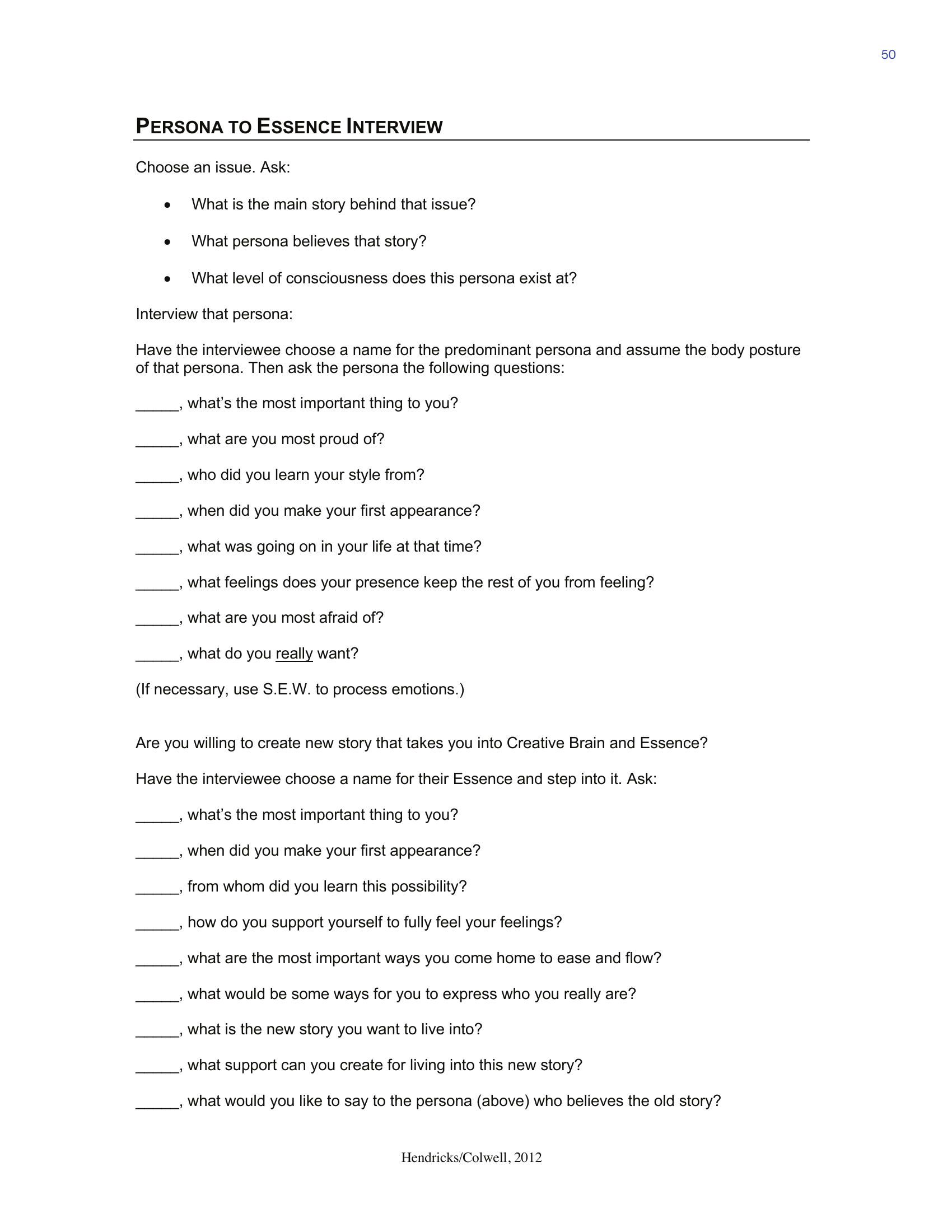
A two-part interview process: first interview the persona that holds the issue at hand, then step out of the persona and interview the essence that can live a new story.
This is the longer-form variant of persona-interviews. Where the basic persona interview names and meets a persona, the Persona to Essence Interview also asks essence to take the wheel — naming who shows up when the persona is set down, and what new story essence wants to live into.
When to use it
- When working an issue and a particular persona is clearly running the show.
- When the practitioner has met the persona once or several times and is ready for the longer move from persona to essence.
- When unconscious-to-conscious-commitments surfaced a deep pattern and the practitioner wants to embody the new commitment through their essence directly.
If SEW is needed mid-process to clear emotional energy, use it. The manual notes this explicitly in the handout: (If necessary, use S.E.W. to process emotions.)
The move
Step 1 — Choose an issue and find the persona
Ask:
- What is the main story behind that issue?
- What persona believes that story?
- What level of consciousness does this persona exist at? (See inner-map.)
Step 2 — Interview that persona
Have the practitioner choose a name for the predominant persona and assume the body posture of that persona. Then ask:
- _____, what’s the most important thing to you?
- _____, what are you most proud of?
- _____, who did you learn your style from?
- _____, when did you make your first appearance? What was going on in your life at that time?
- _____, what feelings does your presence keep the rest of you from feeling?
- _____, what are you most afraid of?
- _____, what do you really want?
(If necessary, use sew to process emotions.)
Step 3 — Invite essence to step in
Ask: Are you willing to create a new story that takes you into Creative Brain and Essence?
Have the practitioner choose a name for their essence and step into it. Then ask:
- _____, what’s the most important thing to you?
- _____, when did you make your first appearance?
- _____, from whom did you learn this possibility?
- _____, how do you support yourself to fully feel your feelings?
- _____, what are the most important ways you come home to ease and flow?
- _____, what would be some ways for you to express who you really are?
- _____, what is the new story you want to live into?
- _____, what support can you create for living into this new story?
- _____, what would you like to say to the persona (above) who believes the old story?
The closing question is the load-bearing one: essence speaks back to the persona, with appreciation. The persona is not banished — it is integrated into a larger system where essence is in charge and the persona is recognized for what it has done.
Why this works
The persona is not the problem. The persona is a defense against overwhelming feeling, formed at a moment when feeling that emotion fully was not possible. Once the feeling moves (via SEW), and once essence has been invited to take a turn at the wheel, the persona’s job changes — it no longer has to run the show because essence has remembered how.
The same body that hosted the persona now hosts essence. The practitioner literally feels different — the posture changes, the voice changes, what’s possible changes.
The handout
Facets served
- facet-navigating-inner-world — primary.
- facet-aligning-with-essence — the essence step is essence work in interview form.
Related principles
- principle-5 — share experience, not advice. The interviewer asks only questions; the practitioner does the discovering.
- principle-19 — group is not therapy. This is somatic, present-moment practice — not analyzing past trauma. The persona-as-defense framing is functional, not diagnostic.
Related tools
- personas — the foundational understanding.
- persona-interviews — the shorter form. Use this when only the first half is needed.
- inner-map — locate where the persona lives on the map.
- unconscious-to-conscious-commitments — often the next move once essence has named the new story.
- essence-interview — the standalone version of the essence half.
- manifesto — the long-form, life-spanning version of the new story essence speaks.
- sew — used as needed mid-process to clear stuck emotional energy.
Source and attribution
Primary source:
raw/The Colwell Practice Immersion Manual-v3 with cover.pdf, Section III (From Projection to Essence: Uncovering the True Self), p. 50 (the canonical handout).
Visual handout:
/assets/colwell-persona-to-essence-interview-050.png.
Lineage: Hendricks/Colwell, 2012 (per the handout footer).
Status notes
canonical — promoted from needs-export 2026-05-25 from the
Colwell Practice Immersion Manual v3 (Section III).