Unconscious to Conscious Commitments
What it is
“If you want to see your unconscious, look at your life.” — Krishnamurti, quoted in Manual v3, p. 76
Roughly 95% of behavior is driven by patterns formed early in life, reinforced through repetition, and stored in the body. Most of these patterns are commitments — but unconscious ones. The Reactive Brain made them long ago, in the service of survival, and they have been running quietly ever since.
This process surfaces an unconscious commitment, lets it be seen with appreciation for what it has done, and replaces it with a conscious commitment chosen from the present moment.
This is not insight-work. The shift is energetic — the body has to move slowly. The mind goes faster than the body; the practice is to give the body time to integrate.
The move
A peer holds space for the speaker. Take your time. Once the speaker has moved past the complaint, give them plenty of time to breathe, move, and be with their experience before moving on.
-
Complain. Ask the speaker to complain about the issue, story, or problem for 1-2 minutes.
-
Reduce the complaint to one sentence. Help the speaker compress to one short, succinct sentence (e.g., “I hate my job.”). Write it down.
-
Substitute “I’m committed to.” Ask the speaker to substitute “I’m committed to” for the first part of the sentence (e.g., “I’m committed to hating my job.”). Repeat the sentence a few times until the speaker begins to wonder what the bottom-line unconscious commitment is (e.g., “I’m committed to not living in my genius.”). Write the unconscious commitment down.
-
Celebrate it. Ask the speaker to repeat the unconscious commitment several times until they can begin to appreciate, and even celebrate it. This sounds counter-intuitive and is the load-bearing move of the practice — see Why celebrate? below.
-
Wonder about its function. Wonder together about the ways the unconscious commitment has really worked for the speaker (e.g., “Not living in my genius has kept me small so I’m not a target for attack.”). List those things.
-
Ask: What do you really want? Come up with a short, juicy sentence. List it.
-
Speak the new commitment. Process any shifts in the body (e.g., “I commit to being fully in my power as I live in my genius.”). Write the new commitment.
-
Action step. Come up with a measurable, pleasurable action step and a by when. List it.
Why celebrate?
The instinct is to be ashamed of the unconscious commitment once you see it. The instruction is the opposite: appreciate it, even celebrate it.
The reason is that the unconscious commitment was, until this moment, running the show — and it worked. Whatever protective function it served (staying small to avoid attack; staying angry to avoid feeling sad; staying busy to avoid feeling alone) succeeded at what it was designed for.
Two things follow from that:
- It is yours. Reactive Brain made it. It belongs to you, not to someone else. That’s what makes a conscious replacement possible — you have authorship now.
- The function is honored, not abandoned. What was the unconscious commitment trying to protect? The new commitment can hold that need consciously — by a different means.
“Look at what I’ve created, and that was all unconscious. Who knows what I’m capable of creating consciously!” — Manual v3, p. 76
After the new commitment lands
Once a new commitment is made, life often delivers a “pop quiz.” The old pattern will reappear — sometimes quickly — giving the practitioner a chance to reaffirm their new choice in real time. — Manual v3, p. 77
This is the work of mastery: not never slipping, but learning how to return again and again to presence and choice.
The post-it practice
The manual offers a tangible anchor:
- On one side of a post-it, write the old unconscious commitment — the one that has been running the show.
- On the other side, write the new conscious commitment — a declaration of who you now choose to be.
The post-it becomes a physical reminder. At any moment, you can turn the page — from old to new, from unconscious to conscious.
The handout
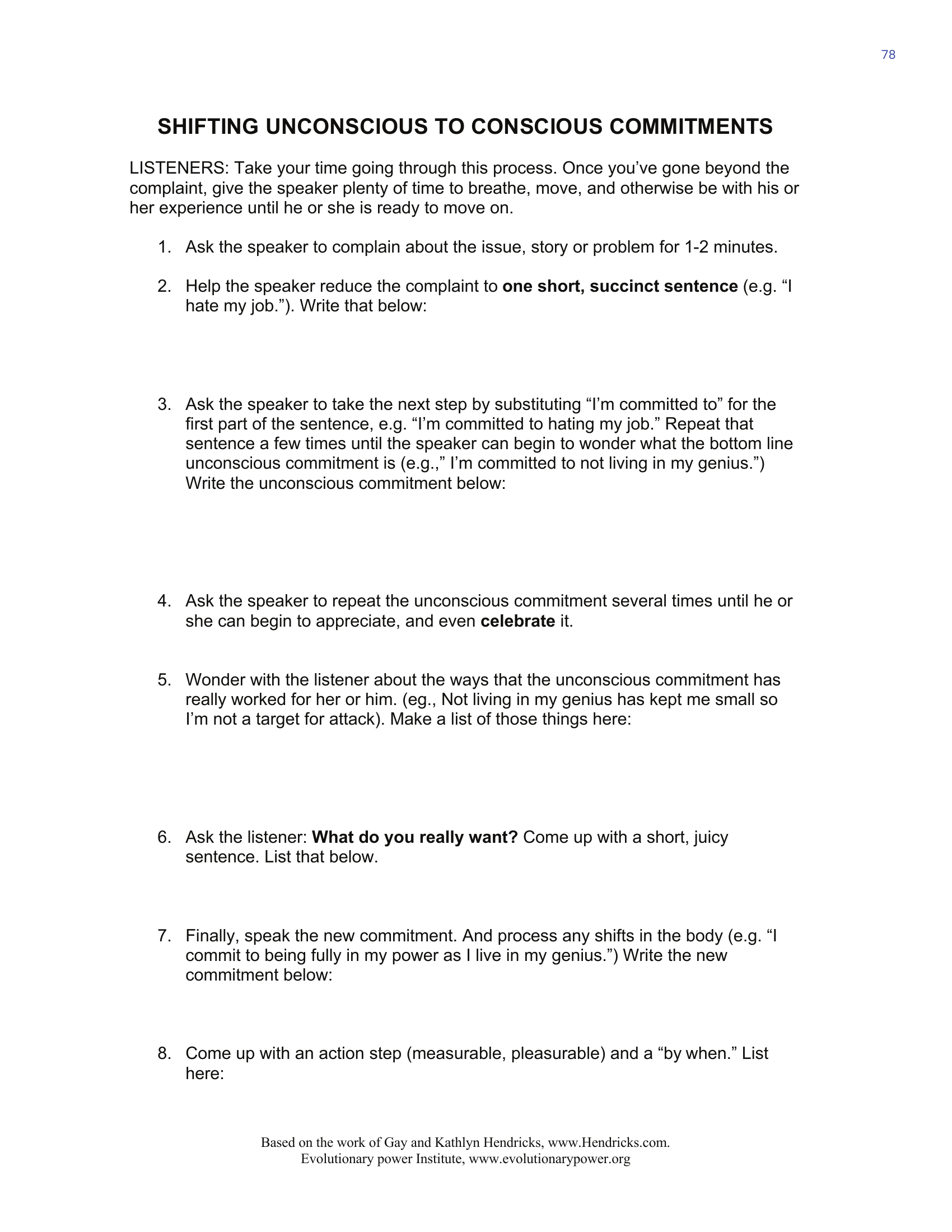
Facets served
- facet-getting-unstuck — primary.
- facet-aligning-with-essence — the new conscious commitment is an essence-aligned declaration.
Related principles
- principle-3 — SEW. Step 6 (“what do you really want?”) is the SEW question unchanged.
Related tools
- inner-map — the manual describes the process as “moving up the tonal scale, or ascending the Inner Map.” Unconscious commitments often surface at the level of Shame; the work supports the speaker through every level up to Pride and over the Bridge into Appreciation and beyond.
- fact — both processes end with what do you really want? + a measurable, pleasurable action step.
- manifesto — a manifesto is the long-form, life-spanning version of a conscious commitment.
- commitments — the practice of working from conscious commitments generally.
Source and attribution
Primary source:
raw/The Colwell Practice Immersion Manual-v3 with cover.pdf, Section VI (Shifting Unconscious to Conscious Commitments: Getting Out of One’s Own Way), pp. 74-79.
Visual handout:
/assets/colwell-shifting-unconscious-to-conscious-078.png— the 8-step handout (p. 78).
Lineage: Gay & Kathlyn Hendricks. The handout names Conscious Loving and Conscious Living as foundational sources; both are recommended as full-book reading in the manual.
Status notes
canonical — promoted from needs-export 2026-05-25 from the
Colwell Practice Immersion Manual v3 (Section VI). The “celebrate
the unconscious commitment” instruction is preserved verbatim because
it is the most easily lost piece — the natural instinct is to shame
or fix, and the practice depends on appreciating instead.