Egg Theory
What it is
A compassionate framework for understanding psychological stress and dysfunction as a spectrum — and a load-bearing diagnostic for when EPI tools are appropriate and when they are not.
Every person exists on a spectrum between mental health and psychosis. The spectrum is not a fixed identity; we move along it based on environment. Supportive conditions stabilize emotional functioning. Stress — especially in intimate relationships — can push someone toward losing a sense of external reality, revealing behaviors that might seem pathological or extreme.
The unconscious mind holds everything that would overwhelm our conscious system: trauma, memory, intense emotion. If all of this flooded awareness at once, it would be paralyzing — “like a computer trying to display an entire hard drive on one screen.”
Defenses are not flaws. They are adaptive mechanisms that protect us from being overwhelmed. The tools of the practice support movement from Reactive Egg (where defense and reactivity reign) to Healthy Egg (where presence and processing can occur).
The five eggs
The diagram (/assets/colwell-egg-theory-101.png) names five
points along the spectrum, each with:
- The state of conscious vs. unconscious content at that point
- The insight, feedback, defenses, and clarity characteristic of that point
- What it looks like in lived experience
- What’s appropriate to do at that point
1. “Creative” — Conscious + Processed
- Insight available.
- Feedback is friendly.
- Defenses are permeable.
- Clarity: what is me, what is the world.
What it looks like:
- Defenses permeable.
- Can retrieve, process unconscious info.
- If unprocessed issues are activated, can process using SEW and other tools.
- Can sort out past from present.
EPI tools land cleanly here. This is the practitioner who has internal stability and is doing growth work.
2. “Reactive” — Unconscious + Unprocessed
- Insight (with support).
- Open to learning.
- Defenses are permeable.
- Clarity: what is me, what is the world.
What it looks like:
- Defenses permeable.
- Unprocessed issues permeate the present.
- Often need support to use EPI tools.
- Liable to resort to drifts to function.
EPI tools land with support here. Most practitioners doing regular practice live here much of the time. This is the workable register.
3. “Overwhelmed” — Unconscious, unprocessed material leaks into present
- Insight (with support).
- Feedback feels scary.
- Defenses have gaps.
- Fuzziness: what is me, what is the world.
What it looks like:
- Defenses have gaps, aren’t working — too much, too fast, too soon.
- The past intrudes on the present.
- Need support to process somatic experiences.
- EPI tools may not be enough. High potential to refer.
⚠️ At this stage, the manual is explicit: the tools may not be enough. A peer holding space should be alert to this and may need to recommend professional support.
4. “Rigid” — Unconscious, unprocessed floods into present
- No insight.
- Feedback is dangerous.
- Rigid defenses.
- It all is the world (not me).
What it looks like:
- Defenses rigid and primitive (externalization, somatization, denial).
- Unconscious unavailable.
- The past overlaps with the present, but can’t integrate that.
- Can’t access sensations.
- EPI tools ineffective when used directly, though could work with exposure over time.
5. “Psychotic” — Unconscious and conscious intermingle, can’t tell the difference
- No insight.
- Feedback is dangerous.
- Defenses have collapsed.
- No ability to sort inner and outer experience.
What it looks like:
- No defenses.
- Unconscious is contaminating the present.
- Triage: get psychiatric support.
- Don’t use EPI tools.
Why this is load-bearing for EPI
This framework is the diagnostic that operationalizes principle-19 (group is not therapy; refer out). Principle 19 says the group is not therapy. Egg Theory says here is how to tell when therapy is what someone needs — and here is why EPI tools, applied to a Rigid or Psychotic egg, will not work and may make things worse.
For peer-led practice especially, this matters: a peer holding space for another person needs a felt sense of which register they’re working in. A practitioner deep in an Overwhelmed or Rigid moment is not a candidate for SEW right now — they need a container that holds them safely while the appropriate support is sought.
The diagram
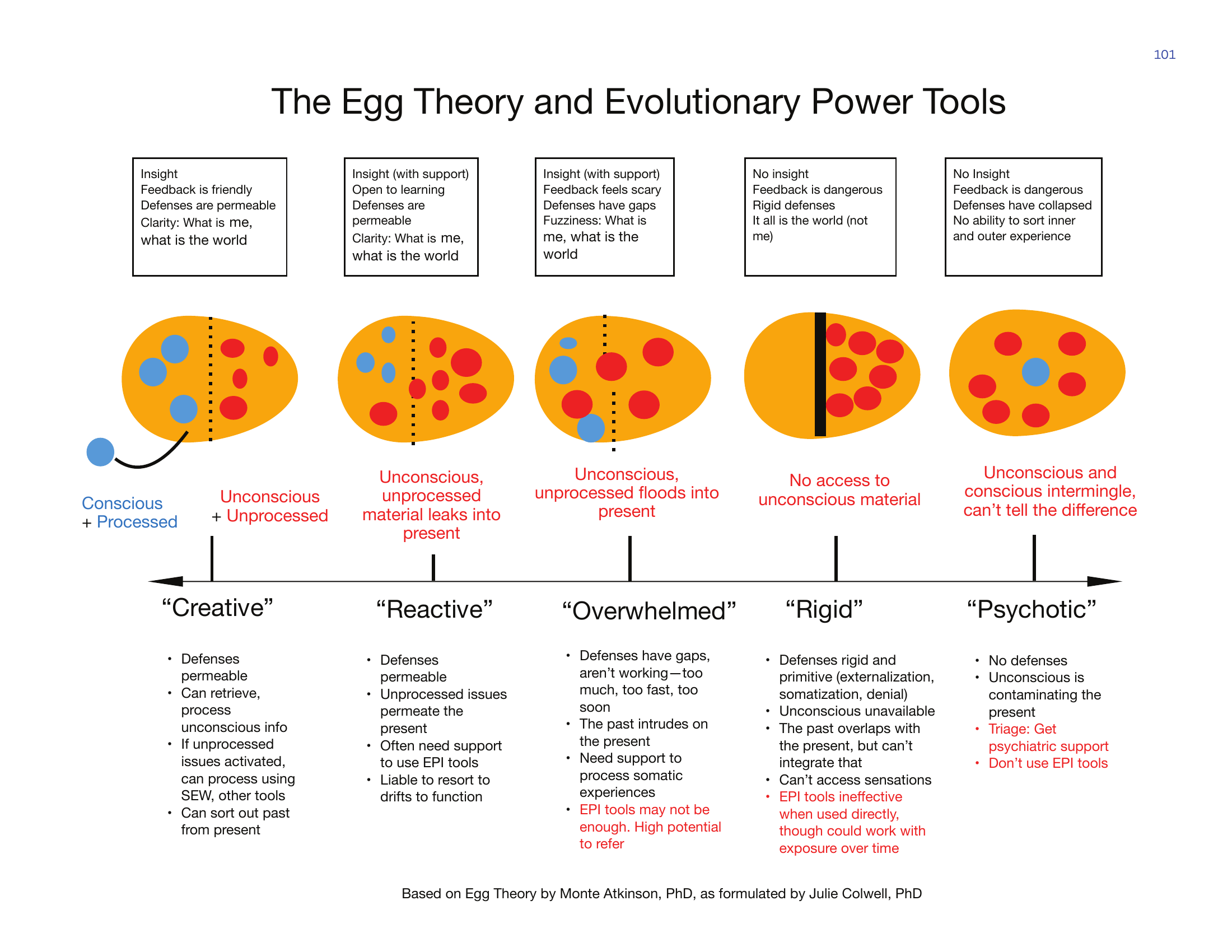
The move
This is more diagnostic than process. The “move” is:
-
Recognize which egg you’re in (or witnessing). Is the person in Creative? Reactive? Overwhelmed? Rigid? Psychotic? Body signals, defense permeability, ability to take in feedback, and clarity about inner/outer all give clues.
-
Match the response to the register. Creative or Reactive → EPI tools work. Overwhelmed → tools with support, but stay alert; referral may be appropriate. Rigid → tools likely won’t land directly; relationship and exposure over time may help. Psychotic → triage; get psychiatric support; don’t use EPI tools.
-
For self-recognition: notice when you have moved from Creative to Reactive to Overwhelmed in your own day. Egg movement is normal. Knowing where you are is the practice.
Facets served
- facet-getting-unstuck — the framework names the spectrum that stuck-ness lives along.
- facet-navigating-inner-world — the egg state is a high-level navigation marker, parallel to the Inner Map.
Related principles
- principle-19 — group is not therapy; refer out. Egg Theory is what makes Principle 19 operational — it names the threshold and the appropriate response.
Related tools
- inner-map — the within-Creative-or-Reactive map. Egg Theory is the broader map that includes when neither map applies.
- fact, sew — the tools that work in Creative/Reactive eggs. Egg Theory names the boundary conditions.
Source and attribution
Primary source:
raw/The Colwell Practice Immersion Manual-v3 with cover.pdf, Section IX (Additional Power Tools), pp. 97-98 (prose) and p. 101 (the canonical diagram).
Visual:
/assets/colwell-egg-theory-101.png— the five-egg spectrum diagram.
Lineage: Originated by Monte Atkinson, PhD. Formulated for the Colwell Practice by Julia Colwell, PhD (per the diagram’s footer).
Status notes
canonical — minted 2026-05-25 from the Colwell Practice
Immersion Manual v3 (Section IX). This page did not previously
exist in the wiki. It is load-bearing for the peer-led modality:
without it, Principle 19’s “refer out” commitment has no
operational diagnostic behind it.