Persona Interviews
What it is
A practiced conversation — solo, in a dyad, or held by a partner — with one of the practitioner’s own personas. The interview treats the persona as a part of the self with its own logic, history, and needs, not as a problem to defeat.
The premise is simple: what we resist persists; what we have relationship with we can influence. A persona that is fought stays. A persona that is met can soften, complete the feeling it was defending against, and release.
The move
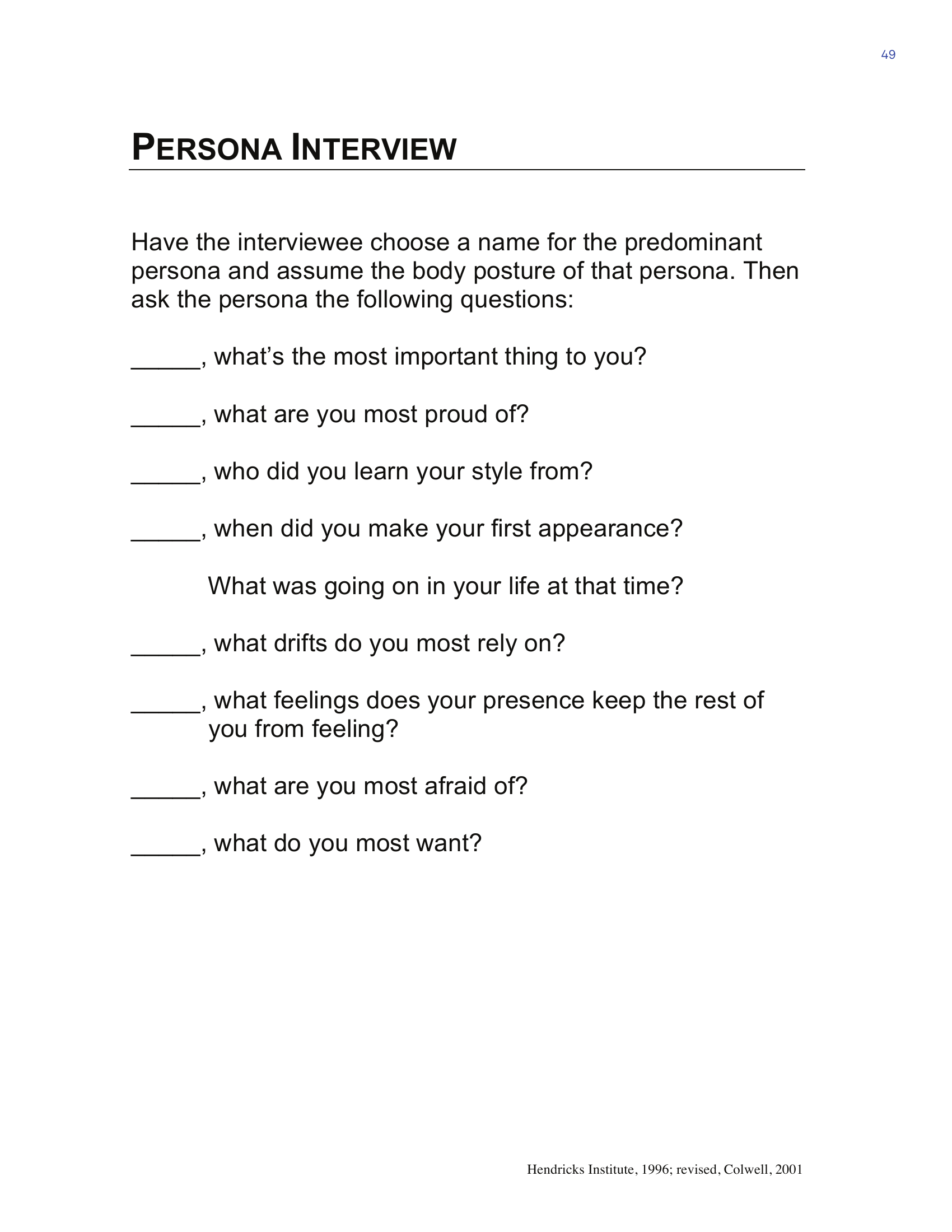
The canonical question list (Hendricks Institute, 1996; revised Colwell, 2001):
Have the practitioner choose a name for the predominant persona and assume the body posture of that persona. Then ask the persona:
- _____, what’s the most important thing to you?
- _____, what are you most proud of?
- _____, who did you learn your style from?
- _____, when did you make your first appearance? What was going on in your life at that time?
- _____, what drifts do you most rely on?
- _____, what feelings does your presence keep the rest of you from feeling?
- _____, what are you most afraid of?
- _____, what do you most want?
The handout
After the interview, the move continues:
- Find the feeling underneath. The persona’s purpose is to avoid a specific feeling. The “what feelings does your presence keep the rest of you from feeling?” question surfaces it directly. Often it is an old feeling — fear that was unsafe to feel as a child, sadness that did not get to complete, anger that had no acceptable expression.
- Run sew through the feeling. With the persona’s permission, let the feeling move. See experiencing-your-feelings, emotional-cycles.
- Thank the persona. It has been working — often for decades — to keep the practitioner safe. The work is meeting and loving the persona, not erasing it.
What the interview is for
- Distinguishing self from persona. The interview itself is the move that creates distance between the practitioner and the persona doing the talking. Identification softens.
- Surfacing the requirement. Most personas have a clear requirement of the world (to be needed, to be admired, to be unseen). Naming the requirement reveals the persona’s hidden contract with reality — and the recurring complaints that come from that contract.
- Reaching the underneath feeling. Personas are sustained because a feeling did not get felt. The interview is the structured way to find that feeling so it can move.
- Working with clusters. Once the practitioner knows several personas, the interview can shift to working with a cluster collectively — how can everyone here get what they want?
In dyads and groups
The curriculum uses dyad practice as the primary form: one practitioner holds the questions, the other answers as the persona. The held space matters — meeting the persona requires the practitioner to drop defenses, which goes more easily when someone else holds the form.
A meeting may hold persona interview practice as a segment of the container (see meeting-script when that piece exists).
Why this matters
Persona interviews are the practical bridge between knowing about personas and actually working with them. Without the interview, the persona stays abstract, and the practitioner remains identified with defenses they have never met directly.
Facets served
- facet-navigating-inner-world — the dedicated practice form of this facet.
- facet-aligning-with-essence — what becomes available once the persona is met and the feeling has moved.
Related principles
- principle-2, principle-3 — SEW runs through the feeling underneath the persona.
- principle-5 — share experience, not advice. The partner holds questions, not answers.
- principle-19 — group is not therapy; the interview is a practice form, not psychological treatment.
Related tools
- personas — the parent framework.
- persona-to-essence — the depth move from persona to the essence underneath.
- projection-work — the outward face of what the persona does in the world.
- sew — the move-through that runs once the feeling is located.
- karpman-triangle — persona families map to triangle positions; interviewing a persona often releases a triangle stance.
Source and attribution
Primary sources:
raw/The Colwell Practice Immersion Manual-v3 with cover.pdf, Section III, p. 49 (the canonical Persona Interview handout with the exact question list).raw/2025 ILC Version AT Master Curriculum.docx.md, Weeks 10 and 11.
Visual handout:
/assets/colwell-persona-interview-049.png.
Lineage: Hendricks Institute (1996), revised by Julia Colwell (2001) — per the handout footer.
Status notes
canonical — canonical handout integrated 2026-05-25 from the
Colwell Practice Immersion Manual v3 (p. 49). The 2026-05-24 ILC
ingest established the page; this pass replaced the partial question
list with the canonical Hendricks/Colwell question set.