Four Pillars of Integrity
What it is
A working definition of integrity as wholeness — not a moral category but an energy category. The Hendricks framing the curriculum quotes directly: “Integrity isn’t a moral issue, it’s an energy issue.”
A practitioner in integrity is whole — energy flows. A practitioner out of integrity has leaks — energy drains. Restoring integrity is restoring the flow of one’s own aliveness, power, and connection.
The Four Pillars name the four places integrity lives. If all four are held, no external dogma is needed — the practitioner is the authority, the author, of their own life.
The four pillars
The manual frames the Four Pillars as a diagnostic tool — four check-in questions when something feels “off”:
- What truth has not been spoken?
- What feelings have not been felt or expressed?
- What agreements need to be made or have been broken?
- Where does 100% responsibility need to be taken?
These map to the four pillars below.
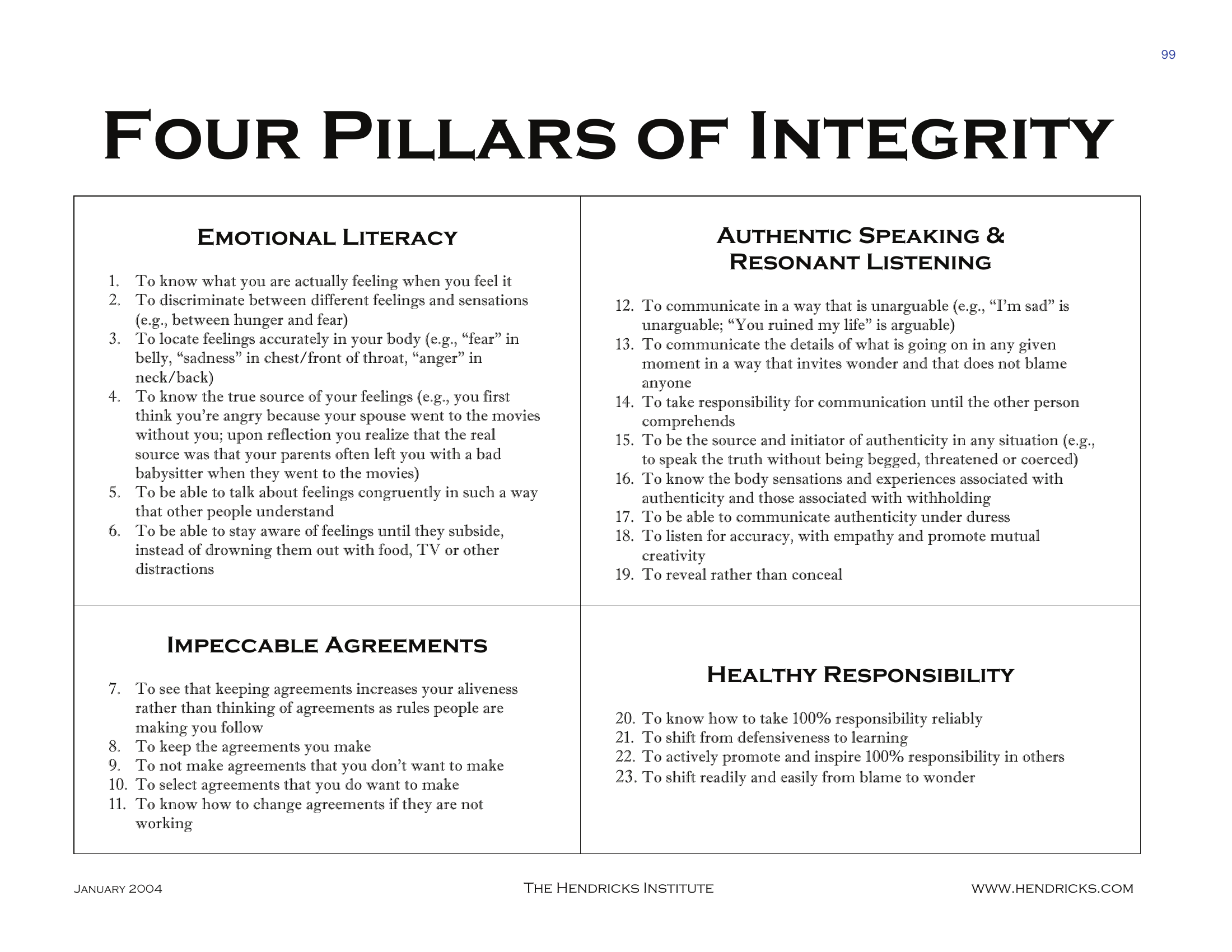
1. Emotional Literacy — integrity with feelings
True to oneself in what is actually felt. Feelings are felt — not numbed, not narrated, not bypassed. The body gets to do its work. (See experiencing-your-feelings, emotional-cycles, sew.)
The Hendricks Institute handout (Manual v3, p. 99) breaks this pillar into six sub-skills:
- To know what you are actually feeling when you feel it.
- To discriminate between different feelings and sensations (e.g., between hunger and fear).
- To locate feelings accurately in your body (e.g., “fear” in belly, “sadness” in chest/front of throat, “anger” in neck/back).
- To know the true source of your feelings.
- To be able to talk about feelings congruently in such a way that other people understand.
- To be able to stay aware of feelings until they subside, instead of drowning them out with food, TV, or other distractions.
2. Authentic Speaking & Resonant Listening — integrity with speaking
Saying out loud what is known to be true for oneself. Withholds are an integrity leak; speaking unarguably restores the connection. (See withhold-withdraw-project, arguable-vs-unarguable.)
Eight sub-skills (handout pp. 99, items 12-19):
- To communicate in a way that is unarguable.
- To communicate the details of what is going on in a way that invites wonder and does not blame anyone.
- To take responsibility for communication until the other person comprehends.
- To be the source and initiator of authenticity in any situation — to speak the truth without being begged, threatened, or coerced.
- To know the body sensations and experiences associated with authenticity and those associated with withholding.
- To be able to communicate authenticity under duress.
- To listen for accuracy, with empathy and promote mutual creativity.
- To reveal rather than conceal.
3. Impeccable Agreements — integrity with action
Choices and agreements align with one’s values and authentic experience. Agreements are made consciously, kept or renegotiated rather than broken silently. (See creative-brain-communication; note the agreement-vs-commitment vocabulary discipline in glossary.)
Five sub-skills (handout p. 99, items 7-11):
- To see that keeping agreements increases your aliveness rather than thinking of agreements as rules people are making you follow.
- To keep the agreements you make.
- To not make agreements that you don’t want to make.
- To select agreements that you do want to make.
- To know how to change agreements if they are not working.
4. Healthy Responsibility — integrity with responsibility
Taking 100% responsibility — for one’s experience, for one’s part, for the world one is in. Not blame (of self or other), not burden. The ability to respond to what is, in the moment. (See karpman-triangle — 100% responsibility = 100% power; the triangle is what happens when responsibility is distorted.)
Four sub-skills (handout p. 99, items 20-23):
- To know how to take 100% responsibility reliably.
- To shift from defensiveness to learning.
- To actively promote and inspire 100% responsibility in others.
- To shift readily and easily from blame to wonder.
The canonical handout
Pillars vs. Cornerstones — what builds on what
The manual distinguishes the Four Pillars from the Four Cornerstones of Evolutionary Power (Julie Colwell’s framing, see colwell-four-cornerstones-100.png):
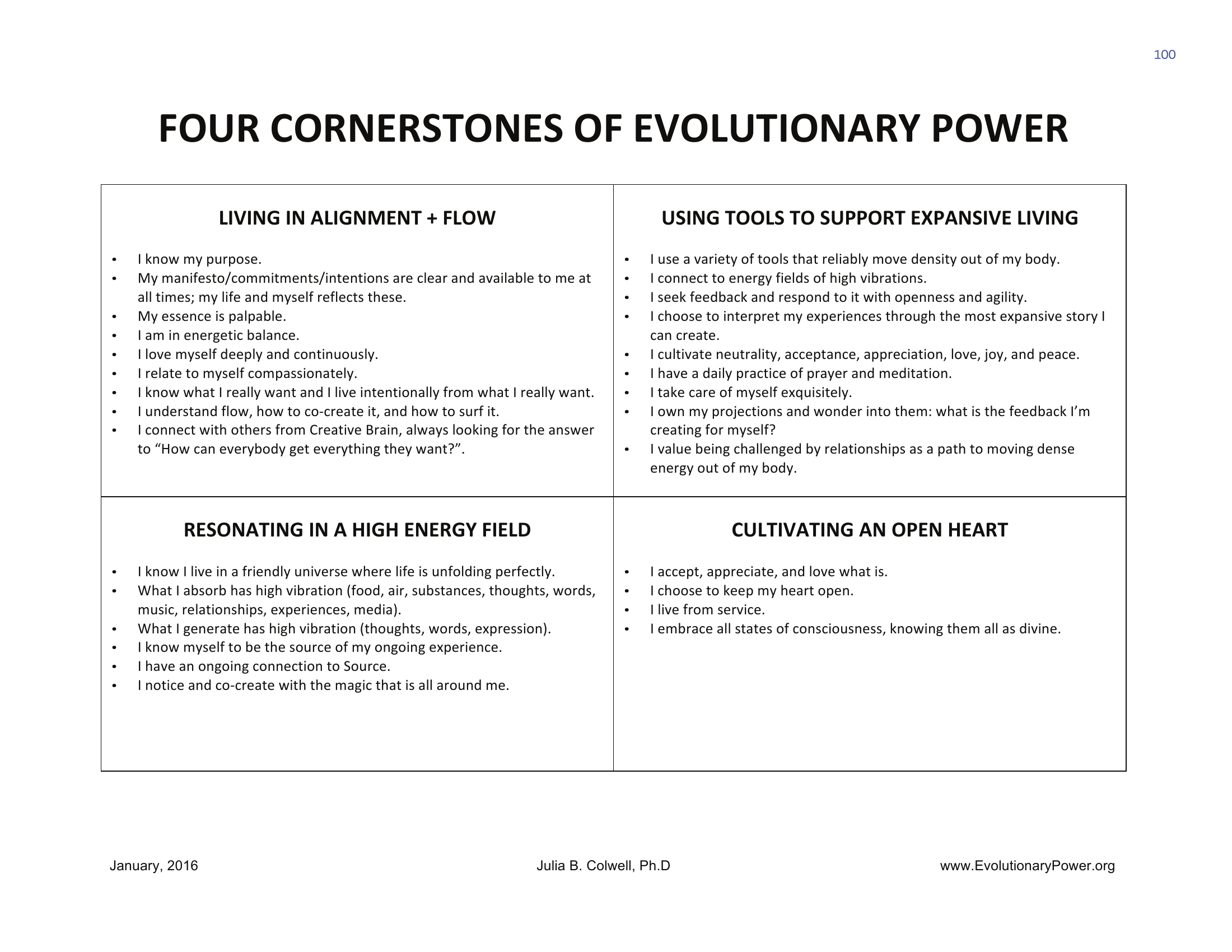
If the Pillars are the structure of the rocketship, the Cornerstones guide where and how that ship is aimed. — Manual v3, p. 97
The Pillars are the integrity foundation. The Cornerstones are the trajectory of growth and transformation — Living in Alignment
- Flow, Using Tools to Support Expansive Living, Resonating in a High Energy Field, and Cultivating an Open Heart.
The Pillars are about being whole. The Cornerstones are about being expansive once whole.
The move
The Four Pillars are practiced as a diagnostic more than as a sequence. When energy is low, when there is conflict, when something feels off, run the pillars:
- What feelings am I not feeling?
- What truth have I not spoken?
- What agreements need to be made or changed?
- Where am I not taking 100% responsibility?
Whichever pillar surfaces an answer is the integrity leak to address. Often it is more than one.
Why this matters
- Integrity = wholeness (think whole numbers). The practice is about being a whole human, not a good one.
- The main ways integrity is lost — and so the main ways power is lost — are: withholds, poor agreements, and incompletions. Each has its own tool. (See withhold-withdraw-project, incompletion-inventory.)
- “Living from full integrity is living from full power.” This is the promise the practice rests on.
- The deepest layer: Am I doing what I most want to be doing during my precious time on earth? Am I cultivating my unique genius? Am I expressing my genius successfully, by my own chosen standards, in the world? (Hendricks, Conscious Loving Ever After, quoted in curriculum.) Integrity is finally about alignment with one’s deepest purpose.
In relationships
The curriculum names a clean diagnostic for relationship conflict — run the Four Pillars on yourself first:
- What feelings aren’t being felt (by me)?
- What truth has not been spoken (by me)?
- What agreements need to be made or changed?
- Where have I not taken 100% responsibility?
This sidesteps the entire blame structure and returns the practitioner to the only place they have power: themselves.
Facets served
- facet-discovering-true-power — the Four Pillars are the operating definition of true power in EPI.
- facet-aligning-with-essence — the deepest pillar layer (purpose, genius) is the territory of this facet.
- facet-translating-body-wisdom — Pillar 1 is body-based.
Related principles
- principle-2, principle-3 — SEW is how the first pillar is practiced.
- principle-5 — share experience, not advice. Speaking experience (Pillar 2) is the practice; advice is outside it.
Related tools
- withhold-withdraw-project — the main repair for Pillar 2.
- incompletion-inventory — the main repair for Pillar 3 and 4.
- karpman-triangle — what happens when Pillar 4 is distorted.
- experiencing-your-feelings — the depth practice of Pillar 1.
Source and attribution
Primary sources:
raw/The Colwell Practice Immersion Manual-v3 with cover.pdf, Section IX (Additional Power Tools), p. 97 (prose, including the Pillars-vs-Cornerstones distinction) and p. 99 (the canonical Hendricks Institute handout with all 23 sub-skills).raw/2025 ILC Version AT Master Curriculum.docx.md, Week 7 (Discovering Your True Power — Integrity).
Visual handout:
/assets/colwell-four-pillars-of-integrity-099.png— the Hendricks Institute handout (January 2004).
Lineage: Gay & Kathlyn Hendricks (Hendricks Institute). Conscious Loving Ever After quoted directly in the ILC curriculum’s advanced-concepts section.
Status notes
canonical — substantially expanded 2026-05-25 from the Colwell
Practice Immersion Manual v3 (Section IX). The full 23-sub-skill
breakdown and the Pillars-vs-Cornerstones distinction were added in
this pass. The 2026-05-24 ILC ingest established the page.