Creative Brain Communication Process — How Everybody Gets Everything They Want
What it is
A structured process for making great agreements when one or more people are stuck in Reactive Brain. The premise is that great agreements come from Creative Brain — and so the work isn’t to argue the agreement, it is to help everyone get above the line first, then let the agreement emerge.
The process answers the question:
“How can everybody get everything they want?”
This is the magic question the manual names — and the answer is neither compromise (which dampens aliveness) nor winning (which keeps the loser in Reactive Brain). The answer is co-creation from a state where all parties’ authentic wants are visible at the same time.
Why compromise isn’t the answer
We’ve been raised on a cultural model that glorifies compromise, teaching us that to maintain peace or connection, someone must give something up. But compromise often leads to resentment, disconnection, and a dampening of aliveness. It’s a short-term solution with long-term consequences. — Manual v3, p. 70
In Creative Brain there is enough — enough time, enough love, enough options, enough power. The scarcity logic of compromise belongs to Reactive Brain.
The three rules of agreement-making
- Only make agreements you truly want to make.
- Do not make agreements you don’t want to make.
- Renegotiate agreements that are no longer working. — Manual v3, p. 70
Resentment is the early signal that an agreement either needs to be made or needs to be updated.
Agreement vs. commitment
An agreement is made between people. A commitment is made between self and Self. (See glossary for the vocabulary discipline.) Don’t confuse the two: a commitment is the work of unconscious-to-conscious-commitments; an agreement is the work of this tool.
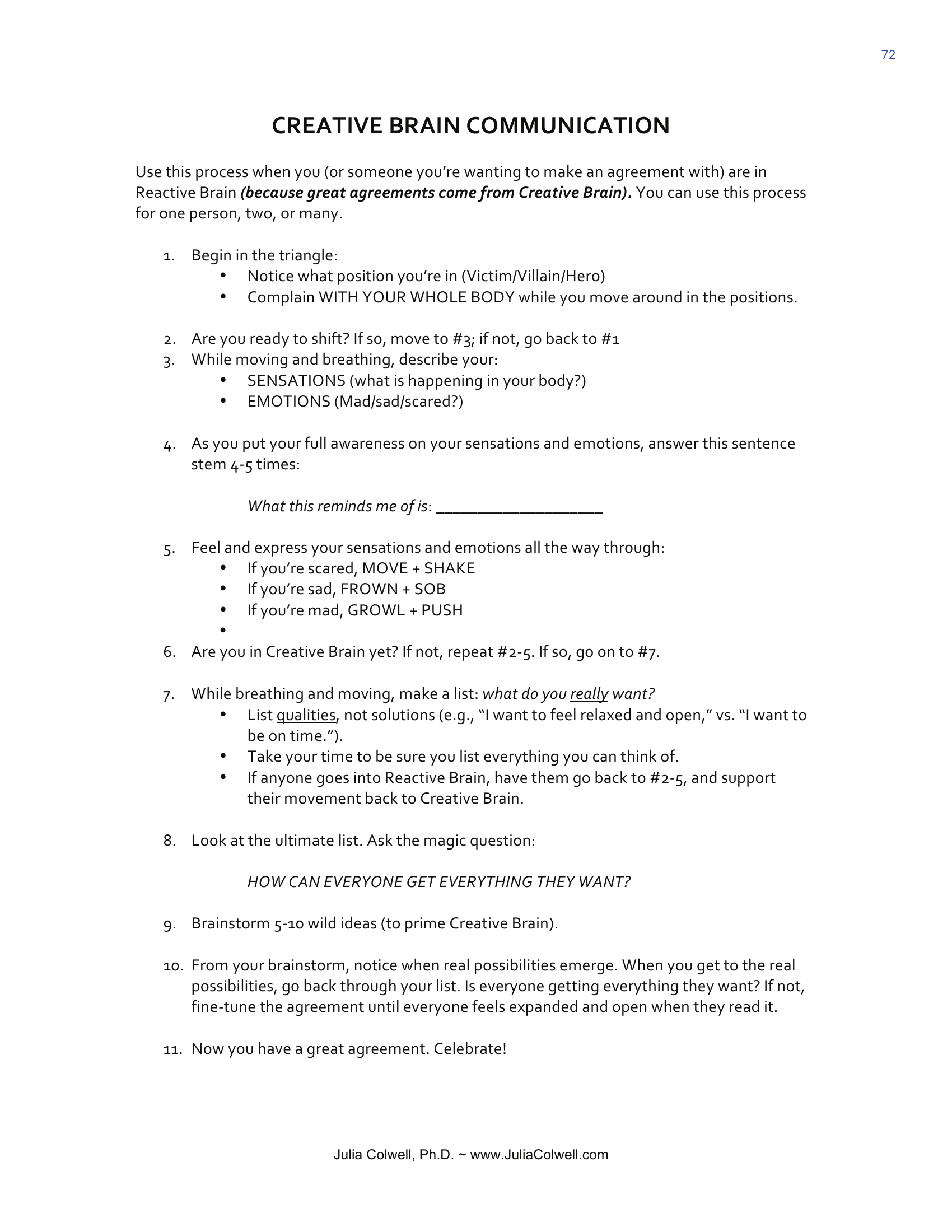
The move — eleven steps
Use this process when you, or someone you’re making an agreement with, are in Reactive Brain. The process works for one person, two people, or many.
-
Begin in the triangle. Notice what position you’re in (karpman-triangle — Victim/Villain/Hero). Complain WITH YOUR WHOLE BODY while moving around in the positions.
-
Are you ready to shift? If so, move to step 3; if not, go back to step 1.
-
Move and breathe. Describe your sensations (what is happening in your body) and emotions (mad/sad/scared?).
-
Sentence stem. As you put your full awareness on your sensations and emotions, answer this 4-5 times: “What this reminds me of is ________________.”
-
Feel and express all the way through.
- If you’re scared: MOVE + SHAKE
- If you’re sad: FROWN + SOB
- If you’re mad: GROWL + PUSH
-
Check. Are you in Creative Brain yet? If not, repeat steps 2-5. If so, continue.
-
List what you really want. While breathing and moving, make a list. List qualities, not solutions (e.g., “I want to feel relaxed and open,” not “I want to be on time”). Take your time. If anyone goes back into Reactive Brain, have them go back to steps 2-5.
-
Ask the magic question. Look at the ultimate list and ask: “HOW CAN EVERYONE GET EVERYTHING THEY WANT?”
-
Brainstorm 5-10 wild ideas. Wild ideas prime Creative Brain.
-
Notice real possibilities. When real possibilities emerge, check the list again. Is everyone getting everything they want? If not, fine-tune the agreement until everyone feels expanded and open when they read it.
-
Celebrate. Now you have a great agreement.
The “they want the same things” reveal
The manual offers a quieter variant for two people working face to face:
- Each person looks the other in the eye and says: “If I get everything I want, I want you to get everything you want.” Pause. This moment alone can reset the nervous system and establish Power With.
- Using sew, each person identifies what they truly want — not surface solutions, but qualities (peace, connection, freedom, respect).
- Write the qualities under each person’s name.
- Each goes through the other’s list and asks: “Do I object to anything here? Do I want them to have what’s on this list?”
- Combine the lists, remove the names. The shared list is the revelation: they want the same things.
From there, brainstorm solutions that meet all the qualities. The agreement that emerges is a vision for the relationship itself.
When this is hard
The cultural belief is that two people can’t both get everything they want. The manual is direct:
Most people don’t believe it’s possible for both to get everything they want. So ask again. Invite them to let their body feel the truth of it. — Manual v3, p. 71
The belief that scarcity is the truth lives in Reactive Brain. The practice is the body discovering that abundance is also true. The process won’t land if the belief isn’t met.
The handout
Facets served
- facet-aligning-with-essence — the process is essence work in two-person form.
- facet-discovering-true-power — Power With in action; the structural opposite of Power Over/Under.
Related principles
- principle-2, principle-3 — SEW is built into steps 3-5 and 7.
Related tools
- karpman-triangle — step 1 begins by naming triangle position.
- sew — the engine inside steps 3-7.
- four-pillars-of-integrity — the integrity-with-action pillar is what conscious agreement-making expresses.
- full-body-yes-no — the body’s “yes/no” is what makes an agreement truly wanted rather than coerced.
Source and attribution
Primary source:
raw/The Colwell Practice Immersion Manual-v3 with cover.pdf, Section V (Creative Brain Communication Process: How Everybody Gets Everything They Want), pp. 68-73.
Visual handout:
/assets/colwell-creative-brain-communication-072.png— the 11-step handout (p. 72).
Lineage: Julia Colwell, PhD. The agreement-making framework draws on Gay & Kathlyn Hendricks’s work, particularly Relationship Skills Workbook (Julie Colwell, ch. 14), which is the recommended reading for this section.
Status notes
canonical — promoted from needs-export 2026-05-25 from the
Colwell Practice Immersion Manual v3 (Section V). The
“no compromise” claim is preserved as-stated and reads cleanly
alongside the great agreements pattern; see
full-body-yes-no for the related friction the team flagged
earlier — this manual resolves it as “no compromise and great
agreements made from Creative Brain.”